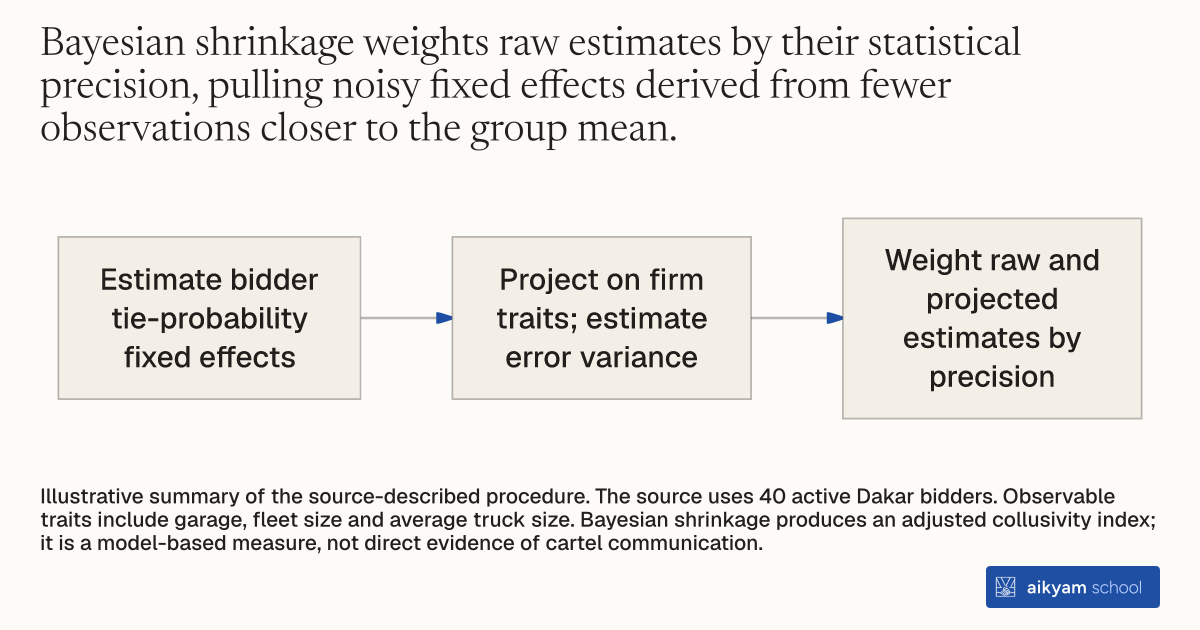
Research steps
Reduce noise in bidder estimates
- Estimate bidder tie-probability fixed effects
- Project on firm traits; estimate error variance
- Weight raw and projected estimates by precision
Illustrative summary of the source-described procedure. The source uses 40 active Dakar bidders. Observable traits include garage, fleet size and average truck size. Bayesian shrinkage produces an adjusted collusivity index; it is a model-based measure, not direct evidence of cartel communication.
See source →How
When to use
Researchers or platform analysts need to estimate firm-level unobserved attributes when individual sample sizes vary across active participants. The method addresses noise, estimation error, and small-sample variance in fixed-effects estimates by shrinking individual firm parameters toward a common prior or observable regression projection. It is designed for econometricians and market designers evaluating persistent provider behavior across repeated procurement auctions.
Correct for estimation noise in bidder fixed effects by shrinking raw fixed-effects estimates toward a projection on observable firm characteristics.
- Estimate raw bidder fixed effects from a probit regression modeling individual tie probabilities in sealed-bid procurement auctions.
- Extract the vector of estimated fixed effects for all active bidders.
- Regress the raw fixed effects on observed bidder characteristics including garage fixed effects, total truck fleet size, and average truck size.
- Calculate the variance of estimation error for each bidder fixed effect.
- Apply a Bayesian shrinkage formula that weights each raw fixed effect against the predicted value from the observable characteristics regression based on estimation precision.
- Construct the final adjusted collusivity index from the shrunk fixed-effect estimates.
Why it works
This attenuates measurement error when using estimated firm attributes to explain strategic bidding choices across different auction formats.
Example
Researchers studying vacuum truck operators in Dakar, Senegal estimated raw bidder fixed effects from a probit model of tie probabilities across 40 active bidders. Applying a Bayesian shrinkage correction projected the fixed effects onto garage locations, fleet counts, and truck sizes, smoothing the collusivity index distribution and attenuating measurement error in subsequent bidding regressions.
About the study
Participants
40 active vacuum truck operators submitting more than 30 valid bids across 3,627 auctions in Dakar, Senegal.
Study Design
Econometric panel study applying a Bayesian shrinkage correction to bidder-level probit fixed effects projected on garage location, fleet size, and truck capacity.
Results
Applying Bayesian shrinkage smoothed the distribution of estimated tie-probability fixed effects across 40 active bidders, confirming that 11 competitive bidders had a shrinkage-adjusted tie propensity under 5% while collusive types averaged a 35% predicted tie probability.