Research steps
Benchmark index insurance against forecasts
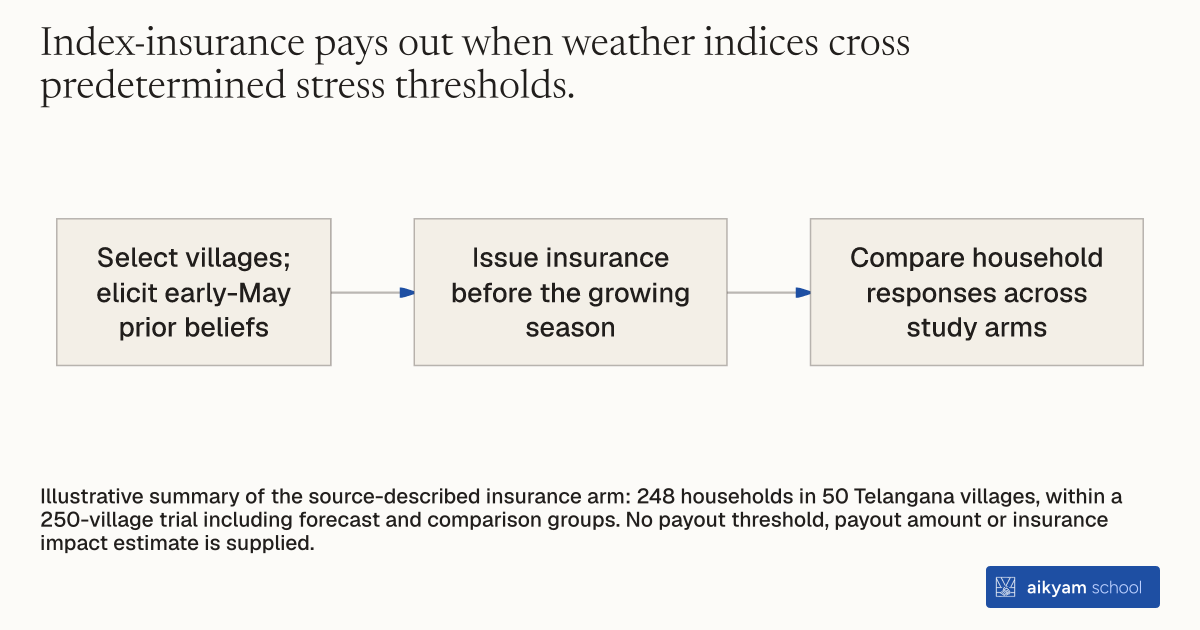
- Select villages; elicit early-May prior beliefs
- Issue insurance before the growing season
- Compare household responses across study arms
Illustrative summary of the source-described insurance arm: 248 households in 50 Telangana villages, within a 250-village trial including forecast and comparison groups. No payout threshold, payout amount or insurance impact estimate is supplied.
See source →How
When to use
Smallholder farmers face severe weather uncertainty during the growing season. Financial risk tools often fail to reach rural producers before weather shocks occur. Offering index-insurance cushions agricultural households against crop losses and benchmarks financial risk management against information provision.
Provide index-insurance products to rural farming households to cushion weather losses and benchmark risk coverage.
- Select rural farming villages in monsoon-dependent agricultural regions.
- Elicit baseline prior beliefs about monsoon arrival timing from target households in early May.
- Issue index-insurance contracts to selected farming households prior to the growing season.
- Evaluate household responses and risk protection against forecast-informed agricultural adjustments.
Why it works
This provides financial protection against adverse weather while allowing policy makers to evaluate how prior expectations shape insurance adoption.
Example
Researchers offered an index-insurance product to 248 farming households across 50 villages in Telangana, India. The team used this intervention arm to benchmark insurance outcomes against long-range forecast delivery in 100 surrounding villages.
About the study
Participants
248 farming households in 50 insurance villages across Telangana, India.
Study Design
Randomized Controlled Trial (RCT) evaluating index-insurance against long-range weather forecasts and comparison groups across 250 villages.
Results
Index-insurance was delivered across 50 villages to benchmark forecast impacts and examine how prior beliefs influence farmer responses to insurance.