Try, learn and adjust
Check crop-price triggers against loan terms
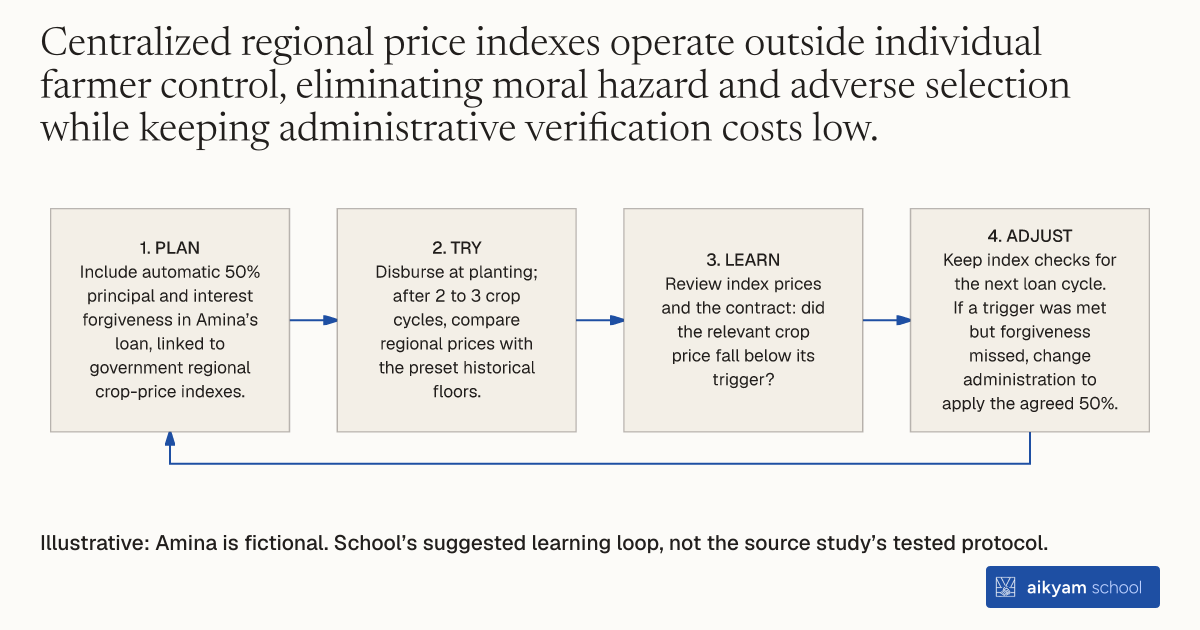
- Plan: Include automatic 50% principal and interest forgiveness in Amina’s loan, linked to government regional crop-price indexes.
- Try: Disburse at planting; after 2 to 3 crop cycles, compare regional prices with the preset historical floors.
- Learn: Review index prices and the contract: did the relevant crop price fall below its trigger?
- Adjust: Keep index checks for the next loan cycle. If a trigger was met but forgiveness missed, change administration to apply the agreed 50%.
Illustrative: Amina is fictional. School’s suggested learning loop, not the source study’s tested protocol.
See source →School’s suggested, untested loop. Observe regional prices and debt adjustments. Compare regional harvest prices with historical floors: the 7th percentile for maize and the 10th for garden eggs. Individual sale receipts do not set the trigger.
How
When to use
This method applies when a microfinance institution or development bank wants to expand credit to smallholder farmers discouraged by downside market price volatility. It solves the problem of default fear driven by post-harvest crop price collapses. The approach provides lenders with a structured loan contract that automatically mitigates price risk without creating individual moral hazard.
Structure credit contracts with an integrated regional crop price indemnity clause that forgives half of debt obligations if regional harvest market prices fall below historical floor thresholds.
- Rural bank credit officers bundle an automatic 50% principal and interest debt forgiveness clause directly into standard farm production loans at baseline interest rates.
- Program officers select target volatile crops and link loan repayment terms to government-collected regional market price indexes rather than individual sales receipts.
- Bank managers disburse loan capital during planting periods, averaging 238 GHS per borrower across maize and garden egg producer groups.
- Government officials track regional harvest market prices following 2 to 3 crop cycles to determine whether average market prices drop below pre-specified percentile floors.
- Rural bank accountants automatically forgive 50% of outstanding loan principal and interest for all borrowers if regional market prices fall below trigger thresholds.
Why it works
Integrating the protection directly into the loan prevents choice overload and decision paralysis among rural clients.
Example
In rural Eastern Ghana, Mumuadu Rural Bank structured loans averaging 238 GHS for 60 treatment smallholders, automatically forgiving 50% of debt if regional Ministry of Agriculture harvest prices fell below historical 7th percentile (maize) or 10th percentile (garden egg) floors.
About the study
Participants
169 smallholder farmers (91 maize farmers, 78 garden egg farmers; 126 reached at follow-up) across 5 villages in rural Eastern Ghana.
Study Design
Clustered RCT comparing loan applications, input investments, crop selection, and marketing channels across 20 group credit marketing meetings offering standard loans versus price-indemnified loans.
Results
Indemnified loan offers maintained high take-up (91.7% treatment vs. 86.4% control), increased garden egg cultivation probability by 17.5 percentage points (p < 0.05), increased chemical input expenditure share by 23.1 percentage points (p < 0.10), and increased sales to market traders by 18.5 percentage points (p < 0.10).