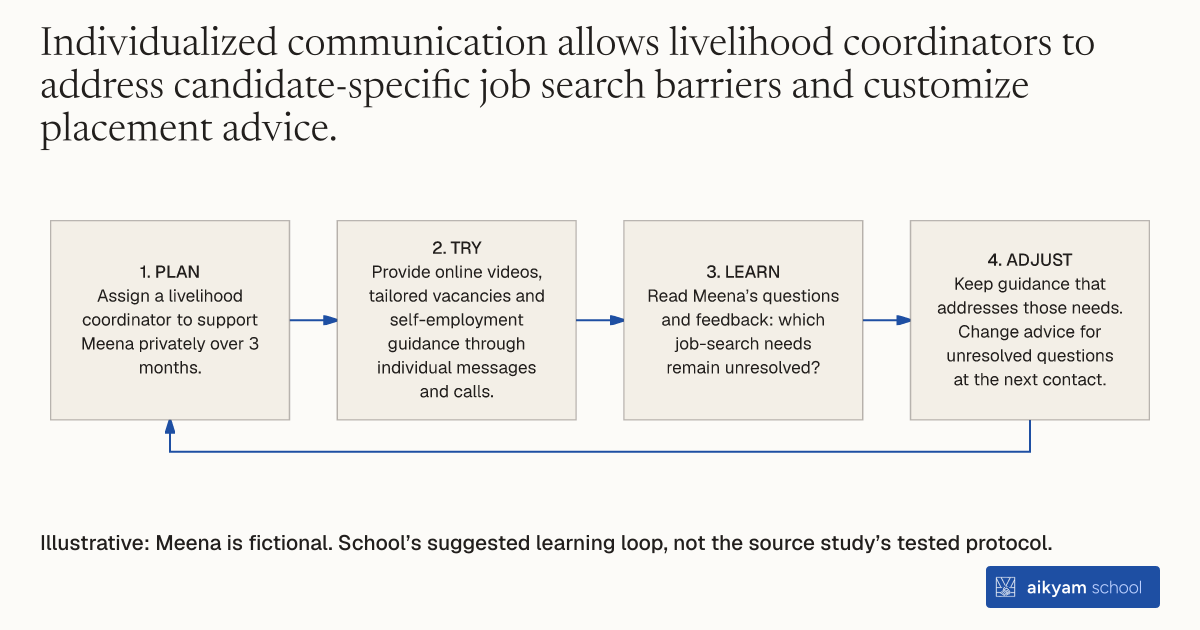
Try, learn and adjust
Check private livelihood advice answers questions
- Plan: Assign a livelihood coordinator to support Meena privately over 3 months.
- Try: Provide online videos, tailored vacancies and self-employment guidance through individual messages and calls.
- Learn: Read Meena’s questions and feedback: which job-search needs remain unresolved?
- Adjust: Keep guidance that addresses those needs. Change advice for unresolved questions at the next contact.
Illustrative: Meena is fictional. School’s suggested learning loop, not the source study’s tested protocol.
See source →School’s suggested learning loop: observe individual communications and job-search questions. Study results are forthcoming; no placement outcome is assumed.
How
When to use
Vocational training graduates often face difficulties securing employment due to non-skill barriers and limited access to job vacancy information. Private one-on-one livelihood assistance provides tailored career guidance to jobseekers who require personalized support for wage employment or self-employment. This method allows organizations to address individual job-search needs directly through remote communication channels.
Deliver tailored wage employment and self-employment assistance to individual jobseekers through private messaging and direct calls over three months.
- Assign a dedicated livelihood coordinator to manage individual communications with vocational trainees.
- Provide trainees with access to online work-readiness and entrepreneurship videos through smartphone messaging applications.
- Conduct one-on-one messaging interactions and direct phone calls between the coordinator and individual trainees.
- Supply tailored job vacancy information and self-employment guidance directly to individual jobseekers over a three-month period.
Why it works
Direct messaging creates a private channel where jobseekers can seek focused feedback on employment opportunities.
Example
Researchers and Yuva Parivartan delivered private post-training assistance to 24 WhatsApp cohorts of young jobseekers in rural and peri-urban Maharashtra, India. A livelihood coordinator provided one-on-one wage and self-employment guidance using individual messaging and calls over three months during COVID-19 restrictions.
About the study
Participants
24 groups containing 10 to 15 young jobseekers each (out of 1,100 total study participants) in peri-urban and rural Maharashtra, India.
Study Design
Four-arm randomized controlled trial comparing online training plus private one-on-one assistance against a control group, online training alone, and online training plus group assistance.
Results
Study ongoing and results are forthcoming; baseline phone surveys established participant employment status and expectations before and during lockdown.