Try, learn and adjust
Check sleep after home support
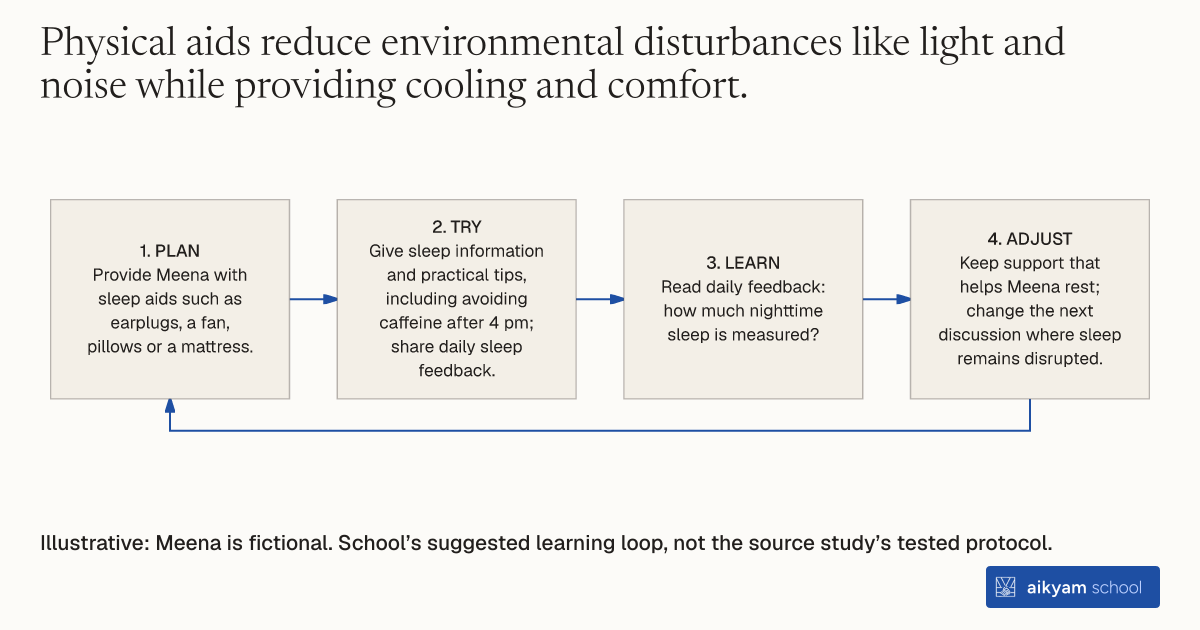
- Plan: Provide Meena with sleep aids such as earplugs, a fan, pillows or a mattress.
- Try: Give sleep information and practical tips, including avoiding caffeine after 4 pm; share daily sleep feedback.
- Learn: Read daily feedback: how much nighttime sleep is measured?
- Adjust: Keep support that helps Meena rest; change the next discussion where sleep remains disrupted.
Illustrative: Meena is fictional. School’s suggested learning loop, not the source study’s tested protocol.
See source →School’s suggested learning loop: Observe measured nighttime sleep. More sleep in the trial did not produce detectable cognition, productivity or well-being gains.
How
When to use
Low-income urban residents suffer from severe sleep disruption due to environmental factors like heat, noise, crowding, and physical discomfort. Supplying physical sleeping aids alongside sleep hygiene guidance helps individuals improve their sleeping environment. This method targets individuals living in challenging urban conditions who struggle to achieve sufficient nighttime sleep.
Distribute environment-improving physical items and personalized sleep counseling to help low-income adults extend their nighttime rest.
- Provide participants with physical items to improve their home sleep environment, such as eye shades, earplugs, pillows, a mattress, or a fan.
- Deliver information on the health and cognitive benefits of sleep to participants.
- Offer actionable sleep hygiene tips, including avoiding caffeine consumption after 4 pm.
- Share daily feedback with participants regarding their measured nighttime sleep duration.
Why it works
Personalized tips and daily feedback increase self-awareness and encourage individuals to allocate more time in bed.
Example
Researchers provided low-income urban workers in Chennai, India, with physical items such as eye shades, earplugs, fans, mattresses, or pillows, along with sleep hygiene tips and daily sleep feedback.
About the study
Participants
452 men and women from low-income neighborhoods in Chennai, India, with an average of 10 years of education.
Study Design
A randomized evaluation comparing participants receiving environment improvements and tips against a comparison group receiving unrelated household items.
Results
The intervention increased nighttime sleep by an average of 27 minutes per night by inducing 38 additional minutes spent in bed, but produced no detectable impacts on cognition, productivity, decision-making, or well-being.