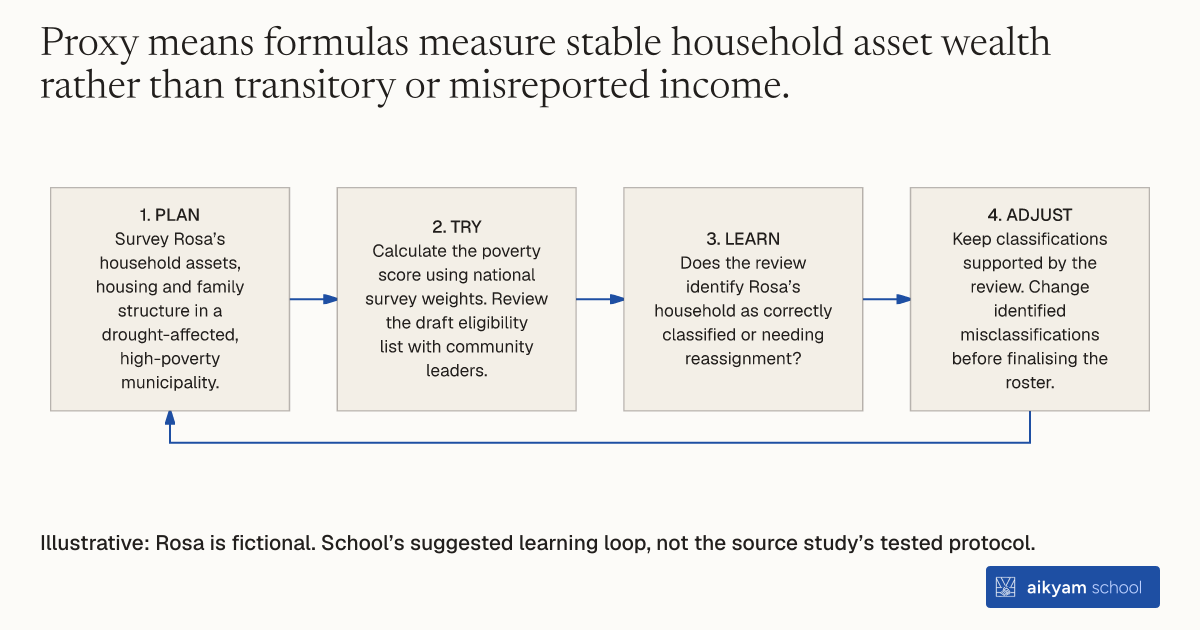
Try, learn and adjust
Check household eligibility with local leaders
- Plan: Survey Rosa’s household assets, housing and family structure in a drought-affected, high-poverty municipality.
- Try: Calculate the poverty score using national survey weights. Review the draft eligibility list with community leaders.
- Learn: Does the review identify Rosa’s household as correctly classified or needing reassignment?
- Adjust: Keep classifications supported by the review. Change identified misclassifications before finalising the roster.
Illustrative: Rosa is fictional. School’s suggested learning loop, not the source study’s tested protocol.
See source →School’s suggested, untested loop. Observe poverty scores and leader-reviewed eligibility changes; this does not establish targeting accuracy.
How
When to use
Governments and development organizations need to target cash assistance to the poorest households during economic or climate crises. Income data in rural developing regions is often unrecorded or unreliable. Combining statistical proxy means scoring with local leader reviews identifies impoverished families accurately while correcting screening errors.
Identify and verify eligible poor households by combining quantitative wealth scoring with local leadership validation.
- Select municipalities affected by drought shocks that also show high extreme rural poverty rates on national maps.
- Collect baseline household survey data on assets, housing quality, and family structure across target communities.
- Calculate a proxy means poverty score for each household using weights from national survey data.
- Hold review discussions with local community leaders to inspect the draft list of eligible families.
- Reassign households identified by local leaders as misclassified to finalize the official participant roster.
Why it works
Reviewing candidate lists with community leaders incorporates local knowledge about sudden personal hardship or unobserved living conditions.
Example
The Ministry of the Family in Nicaragua targeted 3,000 poor households across 6 drought-affected municipalities in rural northwest Nicaragua using a proxy means formula built on 2001 national survey data. Local leaders reviewed the eligible list and reassigned 3.72 percent of households from non-eligible to eligible and 3.65 percent from eligible to non-eligible.
About the study
Participants
4,400 households surveyed across 106 communities in 6 rural municipalities in northwest Nicaragua, where average annual per capita expenditure was around 250 US dollars.
Study Design
Randomized controlled trial across 56 intervention and 50 control communities, evaluating eligibility via intent-to-treat based on the original proxy means score to prevent leader selection bias.
Results
The targeting method successfully identified 3,000 eligible households with 95 percent program take-up and a 1.3 percent attrition rate uncorrelated with treatment status.