Try, learn and adjust
Check eligibility and assembly registration
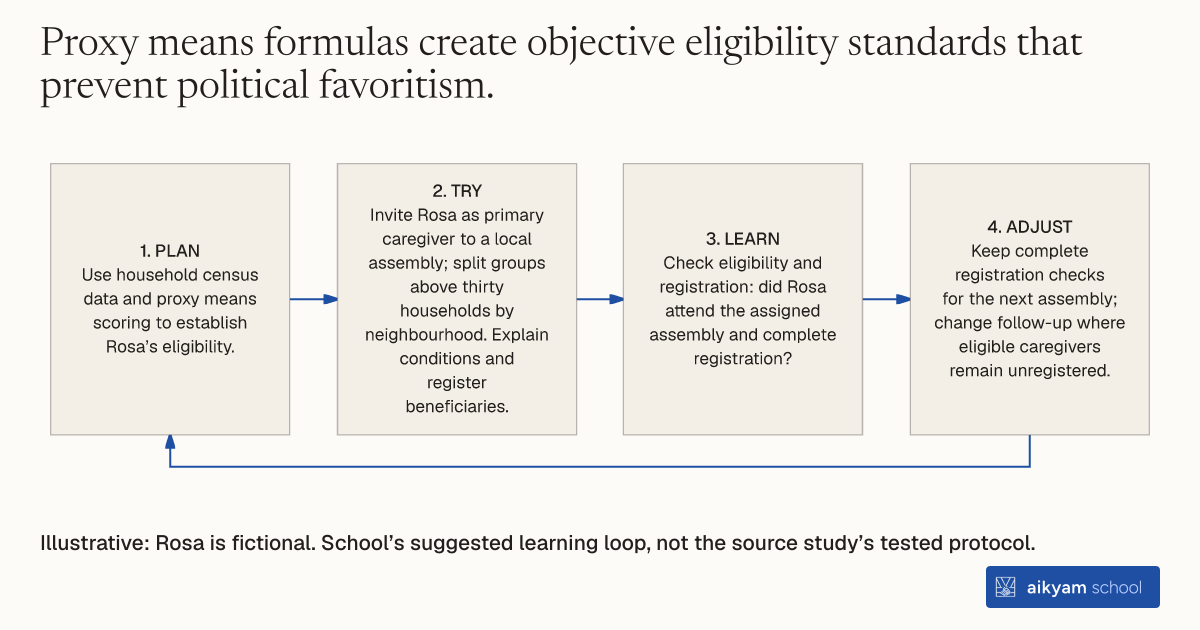
- Plan: Use household census data and proxy means scoring to establish Rosa’s eligibility.
- Try: Invite Rosa as primary caregiver to a local assembly; split groups above thirty households by neighbourhood. Explain conditions and register beneficiaries.
- Learn: Check eligibility and registration: did Rosa attend the assigned assembly and complete registration?
- Adjust: Keep complete registration checks for the next assembly; change follow-up where eligible caregivers remain unregistered.
Illustrative: Rosa is fictional. School’s suggested learning loop, not the source study’s tested protocol.
See source →School’s suggested, untested learning loop. Observe poverty scores, assembly allocation and registration; eligibility does not establish programme effects.
How
When to use
Widespread rural poverty requires objective household identification to direct social assistance to families in need. Unclear eligibility criteria create community mistrust and misallocate program funds. Apply this method when organizing community-wide cash transfer programs for low-income mothers.
Identify eligible poor households using objective proxy means scoring and register primary female caregivers through local assemblies.
- Collect household census baseline data across targeted rural municipalities.
- Calculate a proxy means poverty score for every household to establish program eligibility.
- Convene local registration assemblies in treatment communities, splitting groups exceeding thirty households by neighborhood location.
- Invite the primary female caregiver from each eligible household to attend her assigned assembly.
- Explain program conditionalities and complete beneficiary registration during the assembly.
Why it works
Local assemblies ensure transparent communication and build initial program trust among neighboring caregivers.
Example
In 2006, the Ministry of the Family in Nicaragua used baseline census data and proxy means scoring in six municipalities, identifying over ninety percent of households as eligible and convening 134 registration assemblies.
About the study
Participants
3,000 eligible poor households across 56 treatment and 50 control communities in 6 municipalities of northwestern Nicaragua.
Study Design
Two-stage randomized controlled trial using baseline proxy means scoring to define program eligibility across 106 communities.
Results
More than 90 percent of households in target communities qualified as eligible, resulting in 134 registration assemblies across 56 intervention communities (averaging 2.4 assemblies per community).