Try, learn and adjust
Check asset screening precedes household registration
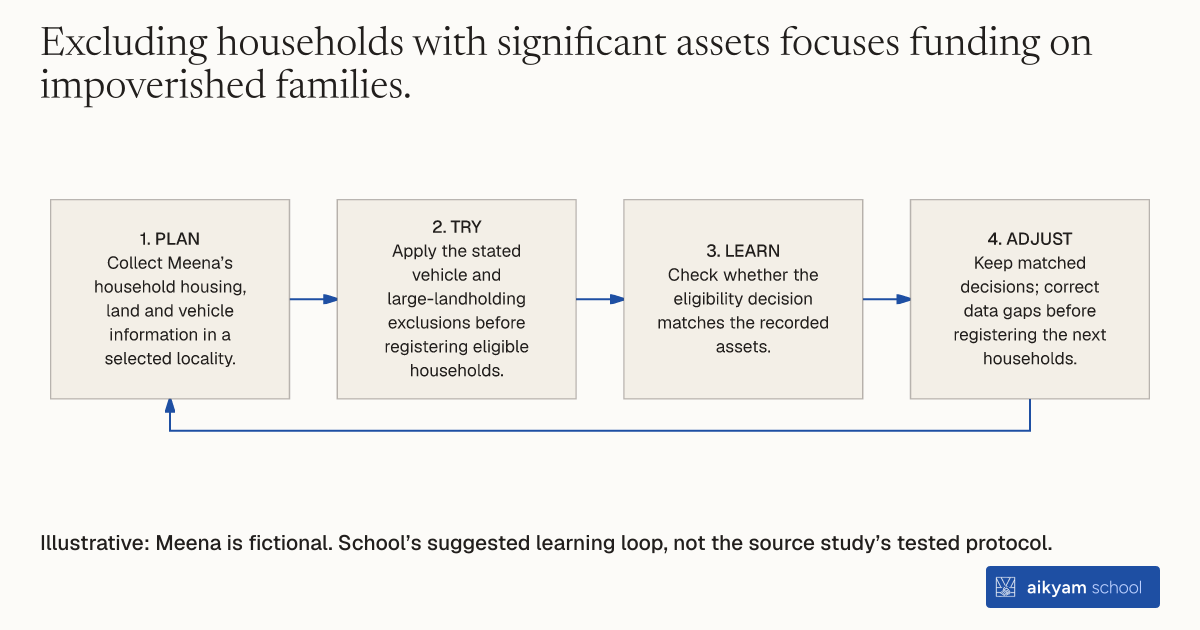
- Plan: Collect Meena’s household housing, land and vehicle information in a selected locality.
- Try: Apply the stated vehicle and large-landholding exclusions before registering eligible households.
- Learn: Check whether the eligibility decision matches the recorded assets.
- Adjust: Keep matched decisions; correct data gaps before registering the next households.
Illustrative: Meena is fictional. School’s suggested learning loop, not the source study’s tested protocol.
See source →Recorded assets and eligibility decisions; no land-size threshold is supplied. School’s suggested learning loop, not a source-tested cycle.
How
When to use
Program managers need to prevent wealthy households from receiving cash transfers intended for poor rural families. Universal eligibility within targeted poor communities can leak funds to wealthy residents who do not need support. Screening households by asset ownership excludes better-off families and protects program resources.
Screen households in targeted localities using physical asset ownership criteria to eliminate wealthy residents before issuing cash transfers.
- Program census takers collect baseline data on housing characteristics, land size, and vehicle ownership for every household in selected localities.
- Program administrators evaluate baseline census data against asset thresholds to identify wealthy households.
- Program administrators disqualify households that own a motor vehicle or possess large landholdings.
- Program staff register only eligible non-excluded households for social protection benefits.
Why it works
This prevents political backlash and maximizes social transfer efficiency in targeted rural areas.
Example
The Nicaraguan Red de Protección Social program surveyed 42 rural localities before launching transfers in 2000. Administrators evaluated baseline census data and excluded approximately 3 percent of households identified as having substantial resources, specifically those owning vehicles or large landholdings.
About the study
Participants
Approximately 10,500 households across 42 rural comarcas in six municipalities in central and northern Nicaragua.
Study Design
Pre-program census screening across 42 randomized evaluation localities using physical asset criteria to identify and exclude wealthy households before baseline random assignment.
Results
Household asset screening successfully identified and removed approximately 3 percent of households with substantial resources from program eligibility prior to transfer distribution.