Research procedure
Simulate targeting by predicted earnings
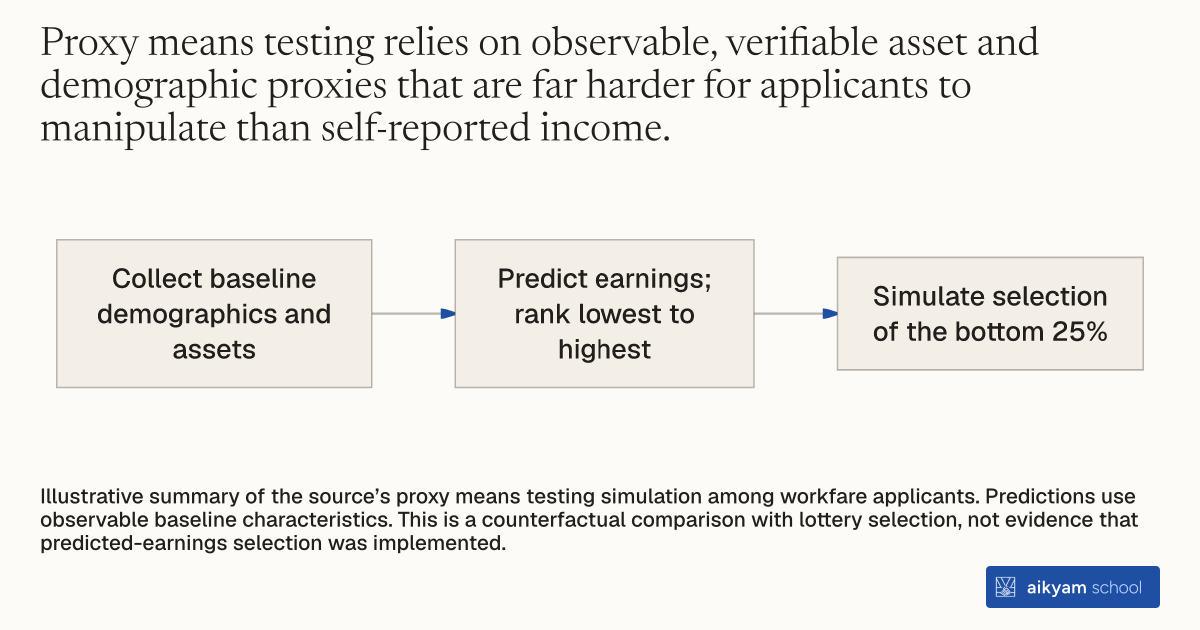
- Collect baseline demographics and assets
- Predict earnings; rank lowest to highest
- Simulate selection of the bottom 25%
Illustrative summary of the source’s proxy means testing simulation among workfare applicants. Predictions use observable baseline characteristics. This is a counterfactual comparison with lottery selection, not evidence that predicted-earnings selection was implemented.
See source →How
When to use
In developing countries with high informal underemployment, self-targeting based on formal minimum wages fails because workfare programs attract relatively better-off applicants alongside vulnerable youth. Direct self-reported income targeting is vulnerable to misreporting when allocating oversubscribed program slots. Proxy means testing predicts baseline economic status using observable, hard-to-falsify characteristics to select the poorest applicants into public works.
Target public works enrollment by predicting applicant baseline earnings using an easily observable, non-manipulable set of demographic and asset indicators.
- Collect baseline applicant characteristics, including gender, age, household size, dwelling characteristics, and durable asset ownership during program registration.
- Estimate a statistical model predicting baseline earnings using these observable covariates.
- Calculate a predicted baseline earnings score for every registered applicant.
- Rank applicants according to predicted baseline earnings from lowest to highest.
- Select applicants in the lowest quartile of predicted baseline earnings to fill available public works program slots.
Why it works
Selecting youth with low predicted baseline earnings isolates inframarginal workers who face lower foregone earnings when taking temporary workfare jobs.
Example
In Côte d'Ivoire, researchers simulated proxy means testing among 2,877 urban workfare applicants using baseline age, gender, household size, and asset variables. Selecting the bottom 25% of applicants based on predicted baseline earnings generated monthly earnings gains during the program of CFA 32,824 per participant, compared to CFA 27,083 under public lottery selection. Post-program monthly earnings gains reached CFA 10,646, lowering the program cost-benefit ratio from 3.03 to 1.99.
About the study
Participants
2,877 urban youth applicants aged 18 to 30 years across 16 localities in Côte d'Ivoire.
Study Design
Randomized controlled trial evaluating workfare beneficiaries, combined with machine learning (Elastic Net) counterfactual simulation comparing outcomes when targeting the bottom 25% of predicted baseline earnings against standard lottery self-targeting.
Results
Proxy means testing targeting increased during-program monthly earnings gains by 21% (from CFA 27,083 under lottery selection to CFA 32,824) and yielded post-program earnings gains of CFA 10,646 per month. This improved the program cost-benefit ratio from 3.03 down to 1.99, achieving a 34% increase in cost-effectiveness.