Research steps
Select poor households through compound scores
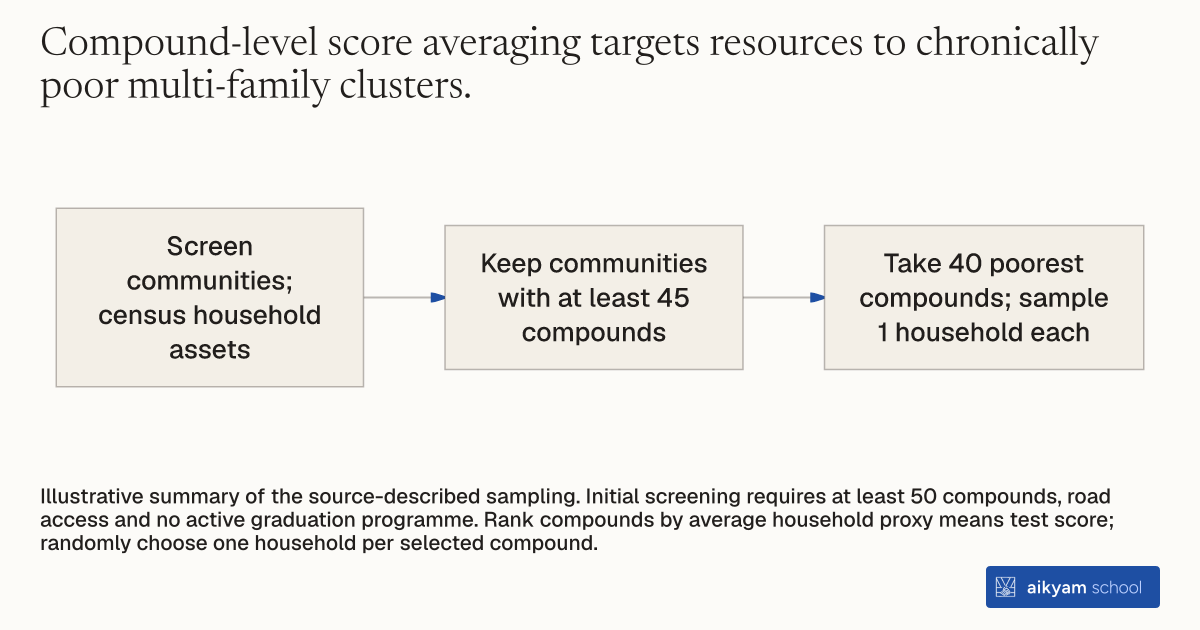
- Screen communities; census household assets
- Keep communities with at least 45 compounds
- Take 40 poorest compounds; sample 1 household each
Illustrative summary of the source-described sampling. Initial screening requires at least 50 compounds, road access and no active graduation programme. Rank compounds by average household proxy means test score; randomly choose one household per selected compound.
See source →How
When to use
Poor rural communities often lack formal income records, making poverty targeting difficult. Multi-family living compounds also create risks of information spillovers across neighboring households. This method helps social programs identify poor study populations across large rural districts.
Identify rural communities and select low-income households using a standardized compound census and proxy means test.
- Meet with district assembly staff to identify communities with at least 50 compounds, road access, and no active graduation programs.
- Conduct a full community census of all households to collect contact details and proxy means test asset data.
- Filter communities to retain those with at least 45 compounds after completing the census.
- Rank compounds by their average proxy means test score and select the 40 poorest compounds per community.
- Randomly select exactly one household from each chosen compound.
Why it works
Selecting a single household per compound eliminates within-compound spillover effects.
Example
Innovations for Poverty Action surveyed 68,309 households across 366 communities in 14 Ghanaian districts. They selected 258 eligible communities meeting the 45-compound threshold and sampled 40 low-income households per community.
About the study
Participants
68,309 households surveyed during census across 366 communities, resulting in 258 eligible communities and 7,445 sampled adults in 14 districts in Ghana.
Study Design
Two-stage sampling protocol combining community screening, census-based proxy means testing across compounds, and single-household compound randomization.
Results
Identified 258 eligible communities with at least 45 compounds and successfully sampled 40 low-income households per community while avoiding compound spillovers.