Research steps
Choose simultaneously before sharing decisions
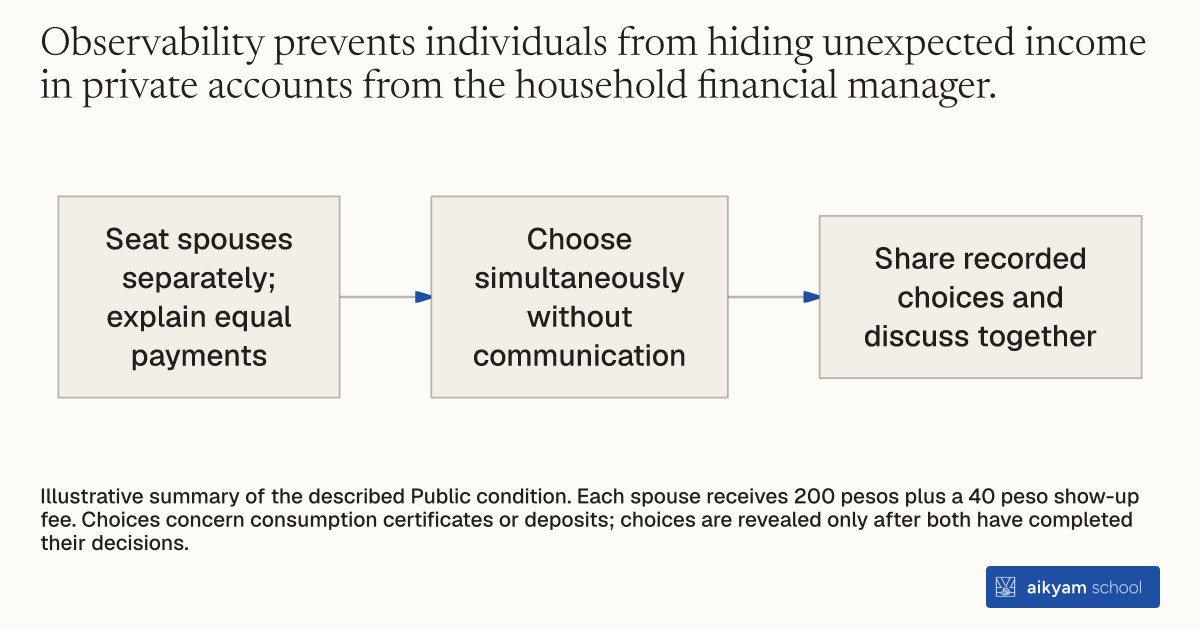
- Seat spouses separately; explain equal payments
- Choose simultaneously without communication
- Share recorded choices and discuss together
Illustrative summary of the described Public condition. Each spouse receives 200 pesos plus a 40 peso show-up fee. Choices concern consumption certificates or deposits; choices are revealed only after both have completed their decisions.
See source →How
When to use
When financial choices are fully observable between spouses but pre-decision communication is restricted, individuals adapt their decisions to avoid spousal reallocation. Observing choices in advance prevents hiding funds while removing communication leaves preference expectations uncertain. This protocol measures how spousal observability without prior discussion influences individual spending and saving decisions.
Bring married couples into the same decision environment to make uncommunicated, observable financial choices simultaneously.
- Local researchers bring husbands and wives into a shared experimental room together.
- Experimenters seat each spouse at separate tables in the same room to prevent communication or visual peeking during decisions.
- Experimenters inform both spouses that they have each received an identical 200 peso endowment alongside a 40 peso show-up fee.
- Experimenters present participants with choices between committed consumption gift certificates and direct deposit into designated accounts.
- Experimenters instruct participants to make decisions independently and simultaneously without speaking.
- Local staff require couples to meet, review, and discuss each other's recorded choices immediately after decision sheets are completed.
Why it works
In response, individuals commit funds to immediate personal consumption before the manager can claim or tax those resources.
Example
Researchers tested 48 married men and 48 married women under public choice conditions at Green Bank in Mindanao, Philippines. When decisions were fully observable without prior communication, 58 percent of men committed their 200 pesos to immediate personal consumption rather than depositing it into an account.
About the study
Participants
146 married couples (291 individuals) recruited near Green Bank in Mindanao, Philippines, with average age of 43 and 19 years married.
Study Design
Randomized field experiment assigning couples to Public, Private, or Negotiation conditions to evaluate allocation choices across 200 peso endowments.
Results
In the Public condition, 58 percent of men chose committed consumption compared to 25 percent in Private (Fisher's exact p-value = 0.002). Men whose wives control savings were 65 percentage points more likely to choose committed consumption in Public than in Private.