Research design
Compare public and private peer rankings
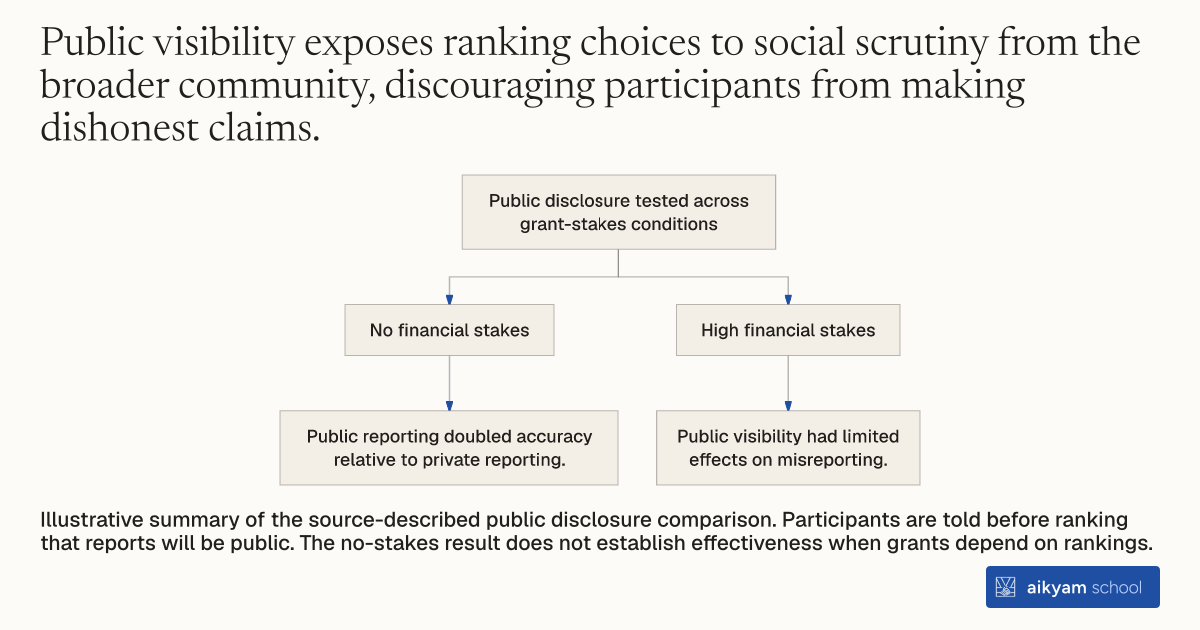
Public disclosure tested across grant-stakes conditions
- No financial stakes
- Public reporting doubled accuracy relative to private reporting.
- High financial stakes
- Public visibility had limited effects on misreporting.
Illustrative summary of the source-described public disclosure comparison. Participants are told before ranking that reports will be public. The no-stakes result does not establish effectiveness when grants depend on rankings.
See source →How
When to use
Survey organizers and program managers need to improve the honesty of peer evaluations in community settings. Private peer rankings allow secretive favoritism or collusion among community members. Disclosing peer survey rankings publicly introduces social visibility and reputational pressure.
Disclose peer evaluation survey rankings publicly to community members to create social transparency and oversight.
- Administer baseline peer ranking surveys to participants within localized peer groups.
- Inform survey participants prior to ranking that peer evaluations will be displayed publicly.
- Post completed ranking results on public display boards or reveal them during community meetings.
- Allow group members to view and inspect the ranking reports provided by their peers.
- Record peer evaluation responses under public viewing conditions to measure changes in reporting accuracy.
Why it works
Fear of social disapproval and damage to personal reputation incentivizes honest reporting when direct financial stakes are absent.
Example
Researchers tested public disclosure of survey rankings among 1,345 microentrepreneurs organized into 274 peer groups in Amravati, Maharashtra, India. Under no-stakes conditions where no financial grants depended on rankings, making rankings public doubled the accuracy of peer reports compared to private reporting. However, when high financial stakes were attached to rankings, public visibility had limited impact.
About the study
Participants
1,345 households organized into 274 peer groups of five microentrepreneurs in Amravati, Maharashtra, India.
Study Design
Randomized controlled trial comparing public disclosure of survey rankings versus private completion across high-stakes and no-stakes grant allocation treatments.
Results
Public reporting doubled survey response accuracy under no-stakes conditions, but had limited effects on reducing strategic misreporting under high-stakes conditions.