Research steps
Test rankings tied to grant chances
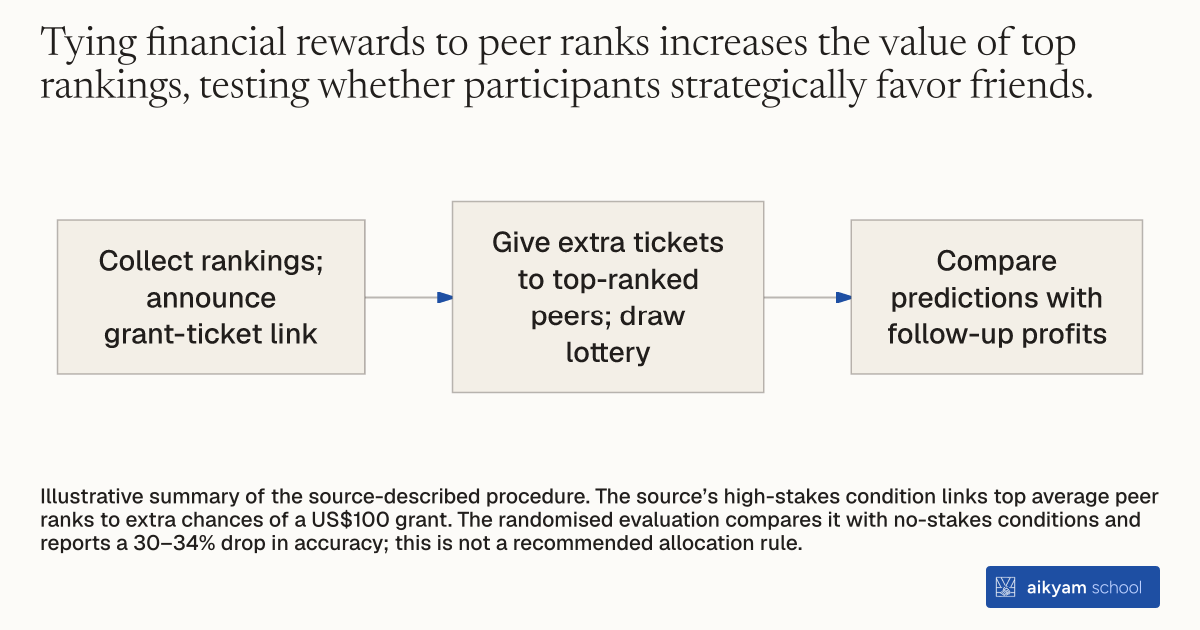
- Collect rankings; announce grant-ticket link
- Give extra tickets to top-ranked peers; draw lottery
- Compare predictions with follow-up profits
Illustrative summary of the source-described procedure. The source’s high-stakes condition links top average peer ranks to extra chances of a US$100 grant. The randomised evaluation compares it with no-stakes conditions and reports a 30–34% drop in accuracy; this is not a recommended allocation rule.
See source →How
When to use
Organizers and policymakers want to allocate valuable grants or loans based on peer nominations. Linking resources directly to survey answers tests whether financial stakes distort peer reporting. Tying grant lottery tickets to top peer ranks tests how strategic behavior affects community data collection.
Link financial grant chances directly to peer survey rankings to evaluate strategic reporting behavior.
- Administer peer ranking surveys asking group members to rank peers on business profit growth potential.
- Announce to participants that top-ranked peers will receive additional lottery tickets for a 100 US dollar cash grant.
- Distribute extra lottery tickets to microentrepreneurs who receive the highest average peer rankings within their group.
- Hold a grant lottery using the distributed tickets to award 100 US dollar cash grants to selected group members.
- Measure ranking accuracy by comparing reported predictions against actual follow-up enterprise profit performance.
Why it works
This intervention establishes a benchmark for measuring strategic misreporting when survey outcomes dictate resource distribution.
Example
Researchers tested high-stakes resource allocation among 1,345 microentrepreneurs organized into 274 peer groups in Amravati, Maharashtra, India. Top-ranked entrepreneurs in high-stakes groups received extra lottery tickets for a 100 US dollar grant. Tying resources to peer rankings caused reporting accuracy to drop on average by 30 to 34 percent due to nepotism and strategic favoritism.
About the study
Participants
1,345 households organized into 274 peer groups of five microentrepreneurs in Amravati, Maharashtra, India.
Study Design
Randomized field experiment comparing high-stakes grant allocation (extra grant lottery tickets awarded to top-ranked peers) against no-stakes conditions.
Results
Ranking report accuracy dropped by 30 to 34 percent when grant allocation was directly tied to peer rankings.