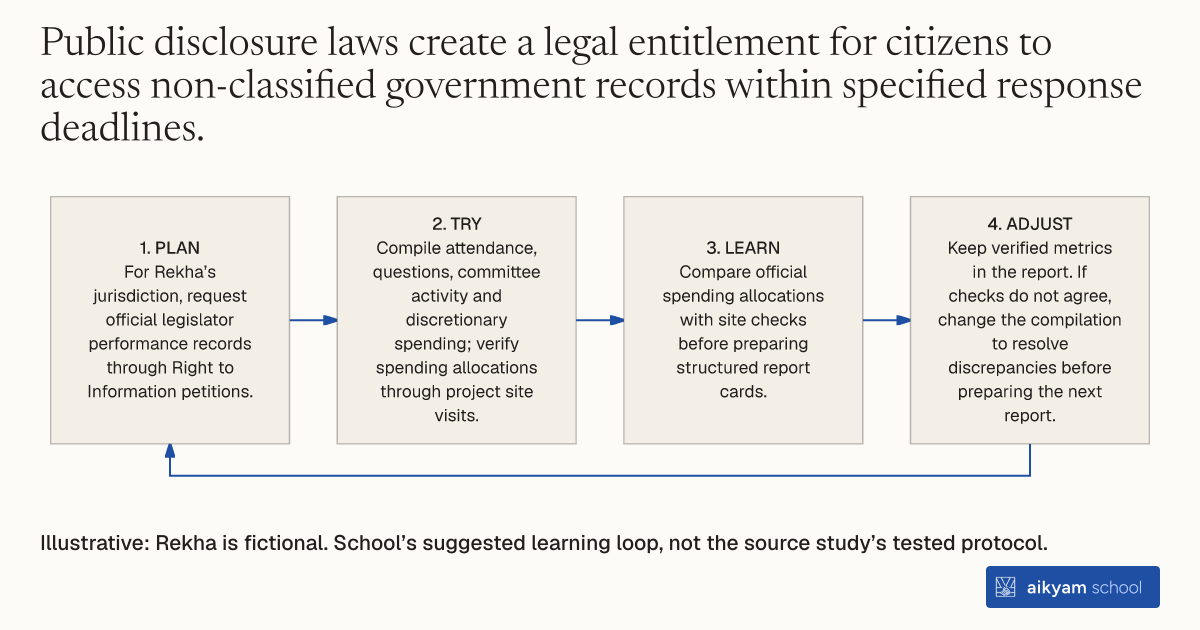
Try, learn and adjust
Verify public performance records before report cards
- Plan: For Rekha’s jurisdiction, request official legislator performance records through Right to Information petitions.
- Try: Compile attendance, questions, committee activity and discretionary spending; verify spending allocations through project site visits.
- Learn: Compare official spending allocations with site checks before preparing structured report cards.
- Adjust: Keep verified metrics in the report. If checks do not agree, change the compilation to resolve discrepancies before preparing the next report.
Illustrative: Rekha is fictional. School’s suggested learning loop, not the source study’s tested protocol.
See source →Observe official records and site verification. This check does not establish effects on voting. School’s suggested learning loop; not a tested source procedure.
How
When to use
Voters in low-income democracies often lack reliable information about politician performance and spending. Official disclosure laws allow citizens to access government records, but these records usually remain unused in public archives. Non-governmental organisations use legal petitions to extract non-classified performance data for public dissemination.
Extract official politician performance records by filing Right to Information petitions with public authorities.
- NGO partners file Right to Information petitions with relevant government authorities requesting non-classified official records on legislator performance.
- Obtain administrative records covering legislator assembly attendance, parliamentary questions asked, oversight committee attendance, and discretionary fund spending.
- Collate official discretionary fund allocations across public good categories including roads, water, parks, sewage, drains, lights, and community halls.
- Verify discretionary spending allocations down to specific project site visits in slum neighborhoods.
- Standardise the extracted performance metrics into structured politician report cards prior to elections.
Why it works
Converting administrative data into structured report cards gives citizens verifiable facts to evaluate elected officials.
Example
An NGO partner filed over 70 Right to Information petitions in Delhi in 2008 to obtain incumbent performance data across 10 electoral jurisdictions before state elections.
About the study
Participants
775 polling stations serving low-income slum households in 10 jurisdictions in Delhi, India, with average household income around 1 dollar a day per person.
Study Design
Randomized controlled trial comparing 200 treatment slums receiving RTI-derived politician report cards against 575 control slums.
Results
Information dissemination using RTI-extracted records increased average voter turnout by 3.5 percent (or 2 percentage points) and reduced cash-based vote-buying by 19 percentage points.