Research procedure
Obtain official performance records
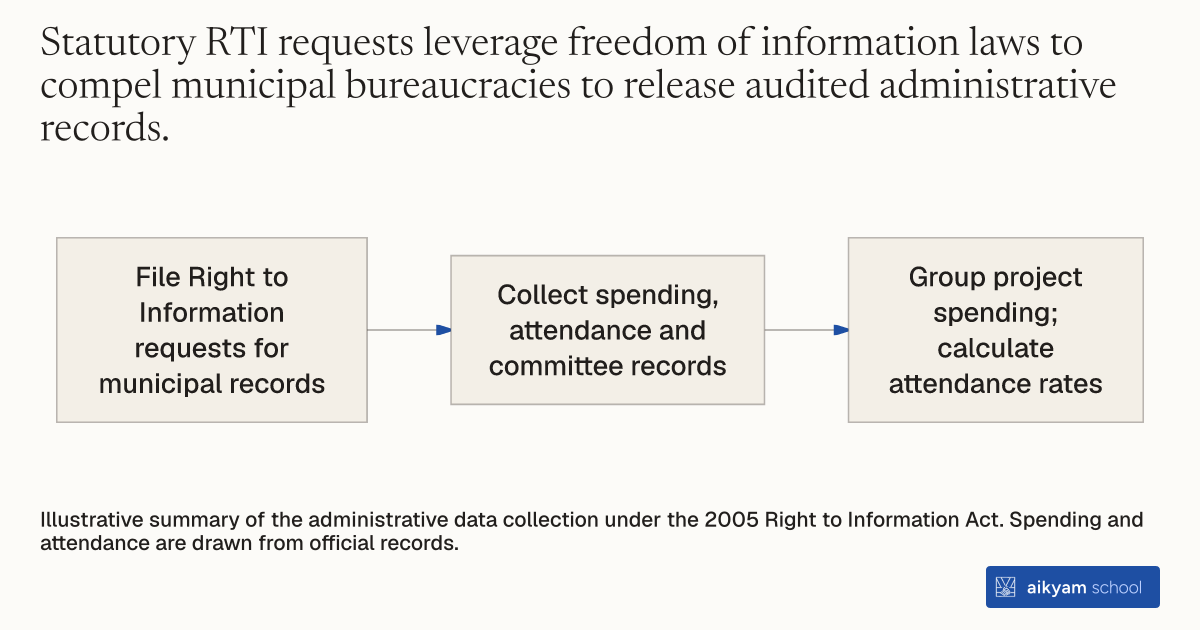
- File Right to Information requests for municipal records
- Collect spending, attendance and committee records
- Group project spending; calculate attendance rates
Illustrative summary of the administrative data collection under the 2005 Right to Information Act. Spending and attendance are drawn from official records.
See source →How
When to use
Voters and civic organizations often lack verifiable, objective information regarding how elected municipal councilors allocate discretionary development funds and attend legislative sessions. Official administrative records exist within municipal bureaucracies but remain inaccessible to the public without formal legal requests. Filing standardized Right-to-Information requests systematically extracts verified councilor performance metrics directly from official government records.
Systematically extract audited administrative performance data on elected representatives using statutory information requests.
- Civil society organizations draft formal information disclosure applications under the 2005 Right to Information Act targeting municipal authorities.
- Submit statutory RTI requests to municipal departments to obtain itemized discretionary fund spending records across development categories.
- Request official legislative assembly attendance logs and standing committee attendance registers for all municipal councilors.
- Categorize itemized discretionary fund spending into standardized project categories including roads, sanitation, parks, schools, and garbage removal.
- Calculate percentage attendance metrics for general assembly meetings and assigned standing committee sessions across each fiscal year.
Why it works
Extracting official government records directly eliminates candidate self-reporting bias and establishes objective benchmarks for evaluation.
Example
In Delhi, India, NGO partner Satark Nagrik Sangathan used the 2005 Right to Information Act to gather performance data for 272 municipal councilors from 2007 to 2012. The retrieved data showed that councilors spent 54% of discretionary funds on roads and 16% on sanitation, while assembly and committee attendance averaged 81% and 66% respectively.
About the study
Participants
240 municipal councilor wards in Delhi, India, covering annual discretionary budgets averaging $200,000 USD per councilor from 2007 to 2012.
Study Design
Administrative data collection using statutory Right to Information requests to track discretionary spending allocations and legislative attendance across 240 city wards.
Results
RTI requests provided comprehensive performance data across 240 wards, establishing that councilors spent 54% of funds on roads, 16% on sanitation, and averaged 81% attendance in assembly meetings and 66% in committee meetings.