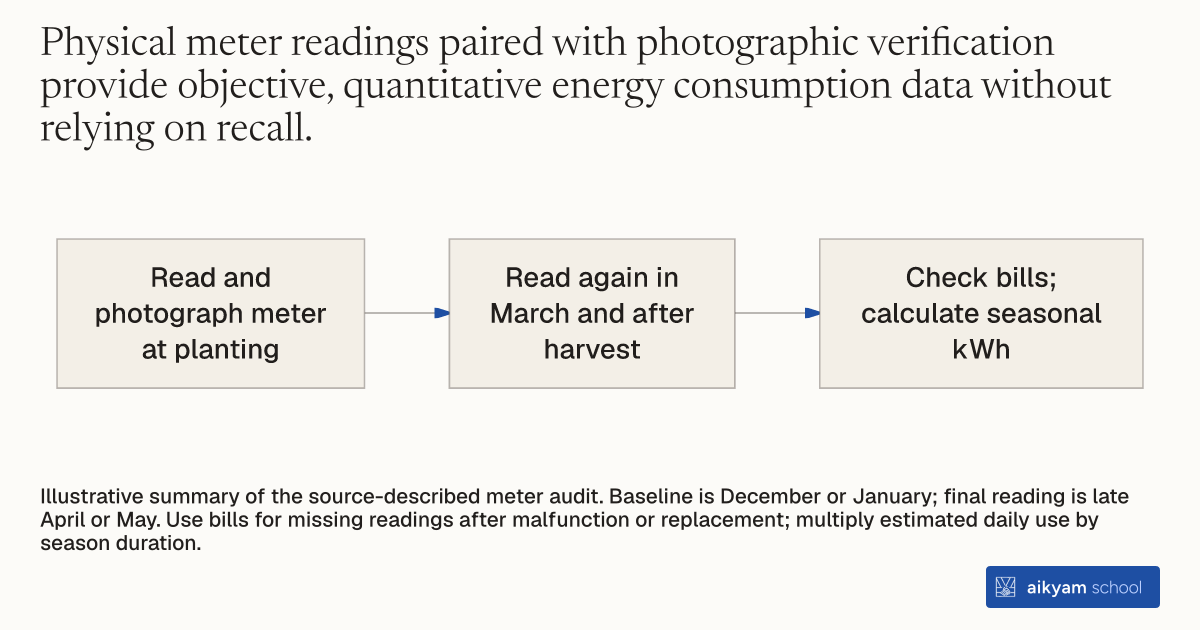
Research steps
Audit pump electricity over the season
- Read and photograph meter at planting
- Read again in March and after harvest
- Check bills; calculate seasonal kWh
Illustrative summary of the source-described meter audit. Baseline is December or January; final reading is late April or May. Use bills for missing readings after malfunction or replacement; multiply estimated daily use by season duration.
See source →How
When to use
Agricultural water pumping relies on electricity meters that are prone to malfunction, misreading, or replacement during the irrigation season. Evaluators measuring agricultural groundwater conservation programs need objective, verifiable energy usage data across rural command areas. Periodic meter audits allow programs to calculate precise seasonal electricity consumption and monitor environmental impact.
Audit and calculate seasonal pump electricity usage through physical meter readings and utility bill verification.
- Surveyors record the initial baseline numerical reading on the agricultural pump's electricity meter at planting time in December or January.
- Photograph the physical meter face to establish visual verification and ensure consistency across survey rounds.
- Conduct a mid-season interim meter reading in March to track ongoing daily energy usage trends.
- Record the final end-of-season meter reading in late April or May immediately after crop harvesting.
- Inspect official utility electricity bills to fill missing data if a meter malfunctions or is replaced during the season.
- Calculate total seasonal kilowatt-hours by multiplying estimated daily usage by the full duration of the growing season.
Why it works
Reconciling field readings against utility billing records ensures complete outcome data even when hardware fails.
Example
Survey teams in Mymensingh and Kishoreganj districts, Bangladesh audited electricity meters on 360 electric tubewells across two annual boro rice seasons (obtaining complete usage data for 307 villages in Year 1 and 305 in Year 2), showing that targeting water sellers reduced seasonal electricity consumption from a control mean of 4,670 kWh down by 38 percent (1,775 kWh saved per pump).
About the study
Participants
N = 360 electric tubewells and command areas serving 2,820 smallholder farmers in Bangladesh (complete electricity usage data obtained for 307 villages in Year 1 and 305 villages in Year 2).
Study Design
Panel monitoring of electric pump meters at planting, mid-season, and harvest across two boro rice cropping cycles, supplemented by billing audits to evaluate randomized subsidy interventions.
Results
Meter auditing revealed that control tubewells consumed an average of 4,670 kWh of electricity per season, and targeting Alternate Wetting and Drying pipe subsidies to tubewell owners reduced seasonal electricity usage by 38 percent (-0.478 log points, saving ~1,775 kWh per pump annually).