Research steps
Record pumping hours against benchmarks
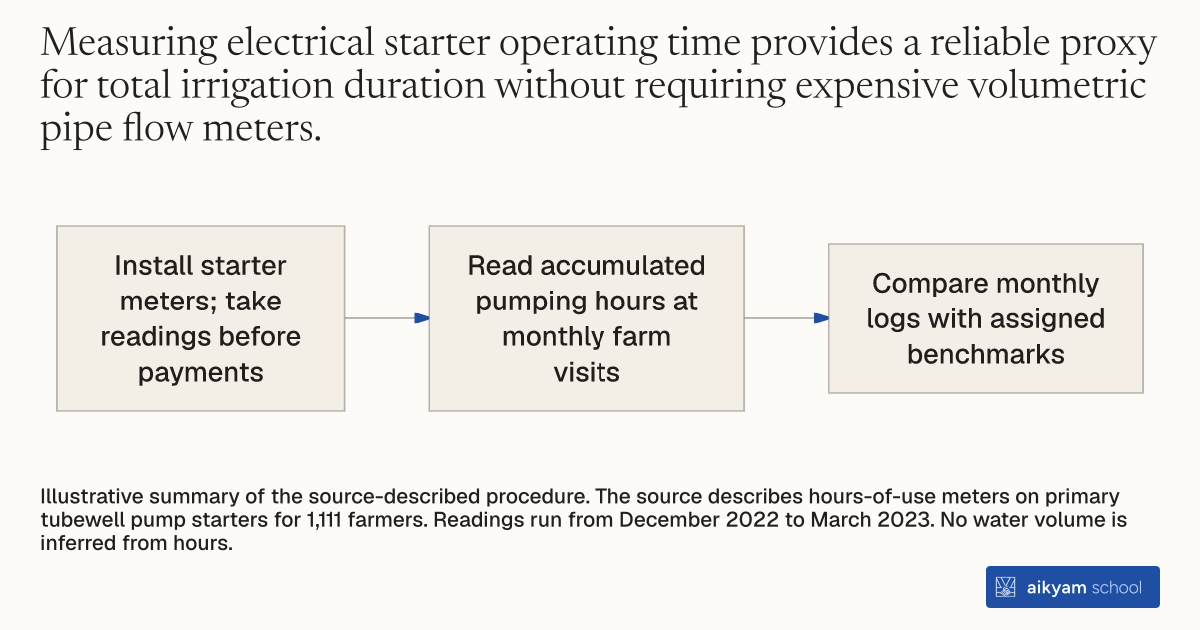
- Install starter meters; take readings before payments
- Read accumulated pumping hours at monthly farm visits
- Compare monthly logs with assigned benchmarks
Illustrative summary of the source-described procedure. The source describes hours-of-use meters on primary tubewell pump starters for 1,111 farmers. Readings run from December 2022 to March 2023. No water volume is inferred from hours.
See source →How
When to use
Unregulated groundwater pumping depletes local aquifers in semi-arid agricultural regions where volumetric water metering is technically or politically impractical. Attaching hours-of-use meters directly to electric pump starters provides an unobtrusive way to track agricultural irrigation duration. Program evaluators use this tracking method to measure baseline pumping behavior and quantify water conservation across smallholder farms.
Install hours-of-use meters on agricultural pump starters to record irrigation duration across smallholder farms.
- Mount an electric hours-of-use meter on the electrical pump starter of each participant's primary tubewell.
- Record initial meter readings before introducing any experimental conservation payments.
- Visit every participating farm once each month from December through March to record accumulated pumping hours.
- Compare monthly meter logs against pre-established pumping benchmarks to calculate individual conservation performance.
Why it works
Regular monthly meter collection provides reliable data to verify pumping reductions and calculate accurate payment rewards.
Example
Researchers in Saurashtra, Gujarat, installed hours-of-use meters on pump starters across 1,111 smallholder tubewell setups. Field staff collected monthly meter readings from December 2022 to March 2023, tracking a baseline and evaluating treatment reductions against monthly pumping benchmarks.
About the study
Participants
1,111 smallholder farmers (from a sampling frame of 1,347 farmers across 1,328 water-sharing pools, after 236 attrited) in Saurashtra, Gujarat, India.
Study Design
Field deployment of hours-of-use meters installed on pump starters of main irrigation sources, monitored monthly over a 3-month season (December 2022 to March 2023) across 5 randomized groups.
Results
Starter meters recorded that farmers offered conservation payments pumped for 10.4 fewer hours per month (a 22 percent decrease) and reduced monthly electricity consumption by 140 kilowatt-hours (a 23 percent decrease) compared to the comparison group average of 611 kilowatt-hours per month.