Research steps
Ask recruiters about screening
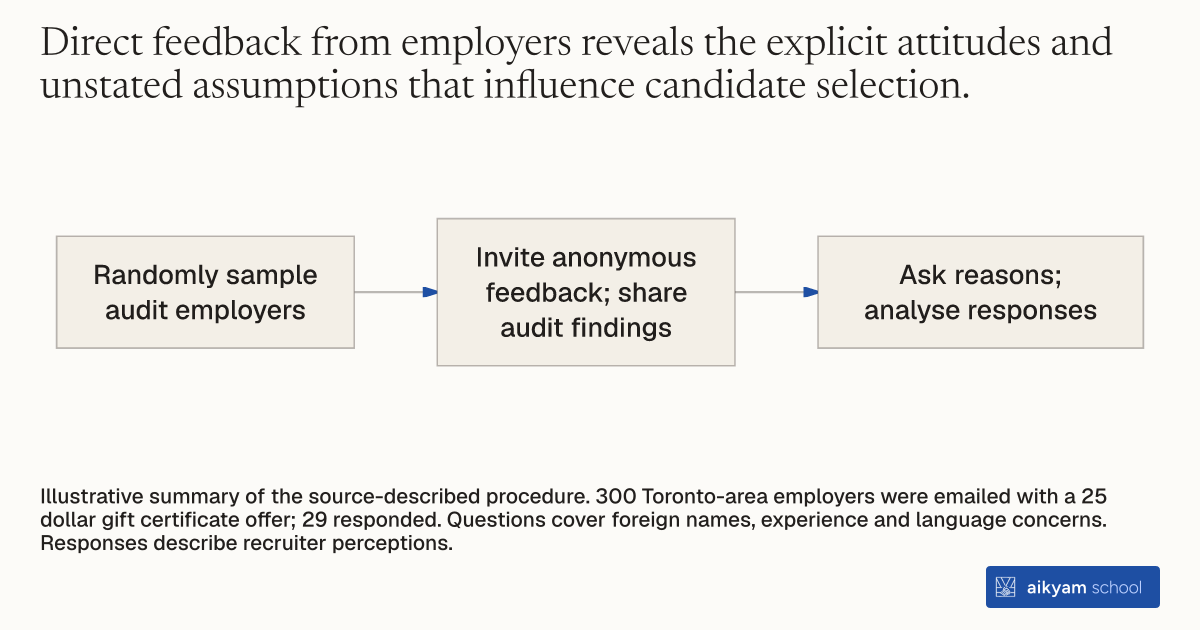
- Randomly sample audit employers
- Invite anonymous feedback; share audit findings
- Ask reasons; analyse responses
Illustrative summary of the source-described procedure. 300 Toronto-area employers were emailed with a 25 dollar gift certificate offer; 29 responded. Questions cover foreign names, experience and language concerns. Responses describe recruiter perceptions.
See source →How
When to use
Labor market researchers need to understand the underlying motives and subjective reasoning behind employer hiring decisions. Quantitative correspondence tests show where discrimination occurs but cannot directly ask employers why they favor certain resumes. This method gathers qualitative insights directly from hiring managers to explain empirical callback disparities.
Conduct an anonymous qualitative survey of employers who previously evaluated mock resumes to identify the reasons for screening decisions.
- Select a random sample of employers who received resume applications during an audit study.
- Send an email invitation offering a financial incentive, such as a twenty-five dollar gift certificate, for participating in an anonymous survey.
- State the main quantitative findings from the resume audit study regarding callback gaps between applicant groups.
- Ask open-ended questions about why recruiters believe candidates with foreign experience or non-English names receive fewer interview requests.
- Inquire specifically whether language skills, risk aversion, or other productivity factors drive the observed callback differences.
- Record and analyze the qualitative responses to identify recurring employer justifications and cognitive biases.
Why it works
Comparing recruiter statements with resume audit data helps researchers determine whether hiring penalties stem from rational skill concerns or unconscious stereotyping.
Example
Philip Oreopoulos emailed 300 employers in the Greater Toronto Area who received mock resumes in his audit study, offering a twenty-five dollar Amazon gift certificate for anonymous feedback. Twenty-nine recruiters responded, with almost all stating that employers treat foreign names and foreign experience as signals of inadequate English language skills.
About the study
Participants
N = 29 recruiters and human resource managers responding out of 300 contacted in the Greater Toronto Area, Canada.
Study Design
Qualitative survey and interview follow-up with employers drawn from a randomized resume audit field experiment.
Results
Recruiters overwhelmingly cited English communication concerns and risk aversion as the primary drivers of screening penalties, with 29 out of 29 respondents attributing lower callback rates for foreign-named or foreign-experienced resumes to presumed language deficits.