Try, learn and adjust
Use daily defect records to guide repairs
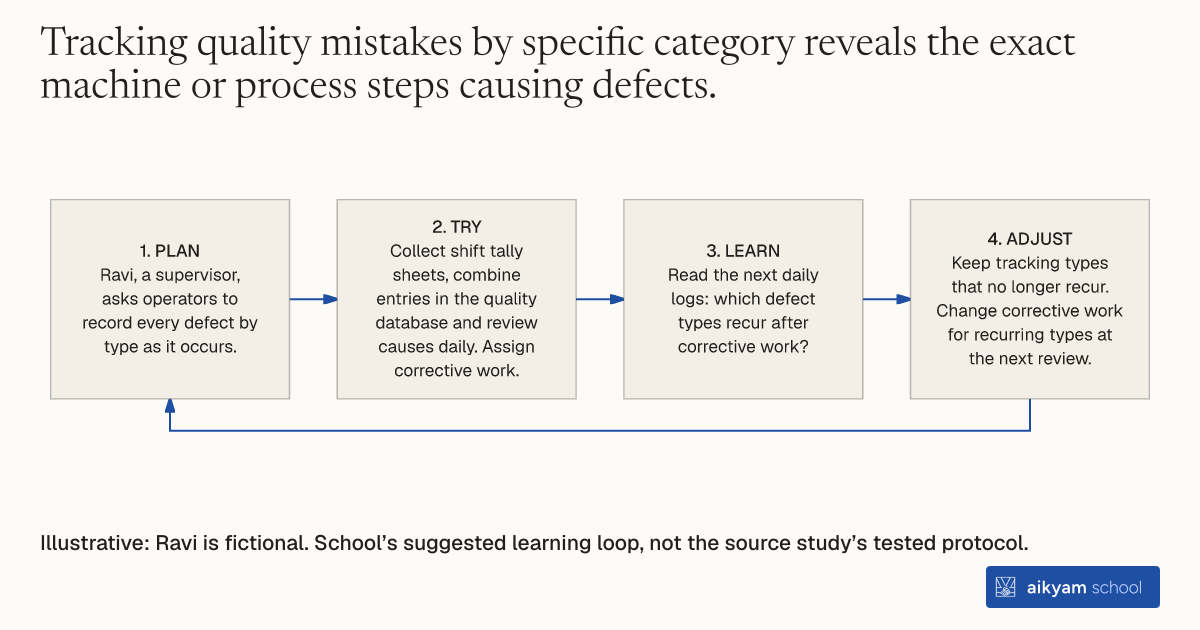
- Plan: Ravi, a supervisor, asks operators to record every defect by type as it occurs.
- Try: Collect shift tally sheets, combine entries in the quality database and review causes daily. Assign corrective work.
- Learn: Read the next daily logs: which defect types recur after corrective work?
- Adjust: Keep tracking types that no longer recur. Change corrective work for recurring types at the next review.
Illustrative: Ravi is fictional. School’s suggested learning loop, not the source study’s tested protocol.
See source →School's suggested, untested loop: observe defect types, assigned corrections and subsequent logs; no reduction is assumed.
How
When to use
Disorganized production in manufacturing plants creates frequent quality defects like stains, broken threads, and color errors. Finding and repairing these errors post-production requires large mending teams and consumes extensive labor. Recording quality defects by specific type and analyzing logs daily allows managers to identify and correct root operational causes.
Record quality defects daily by specific type on the factory floor and analyze logs to resolve root causes.
- Direct machine operators to log every quality defect on floor tally sheets as mistakes occur.
- Require floor supervisors to gather defect tally sheets from all plant sections at shift end.
- Direct managers to combine daily defect entries into a centralized quality tracking database.
- Require plant managers to review defect logs in daily operational meetings to pinpoint root causes.
- Assign maintenance crews and supervisors to correct machine or material issues causing top defect types.
Why it works
Fixing root causes prevents recurring mistakes and reduces labor spent on product mending.
Example
Consultants helped managers in twenty-eight textile plants near Mumbai, India, record quality problems by type and analyze records daily, cutting total quality defects by roughly fifty percent.
About the study
Participants
Seventeen large textile manufacturing firms with twenty-eight factory plants near Mumbai, India, averaging 270 employees, US$13 million in assets, and US$7.5 million in annual sales per firm.
Study Design
Randomized controlled trial testing an intensive four-month consulting intervention that introduced systematic defect logging and daily record analysis across treatment plants.
Results
Recording quality defects by type and analyzing daily records cut quality defects by roughly 50 percent, substantially lowering the 19 percent factory manpower overhead spent on checking and mending.