Try, learn and adjust
Use defect records to identify recurring flaws
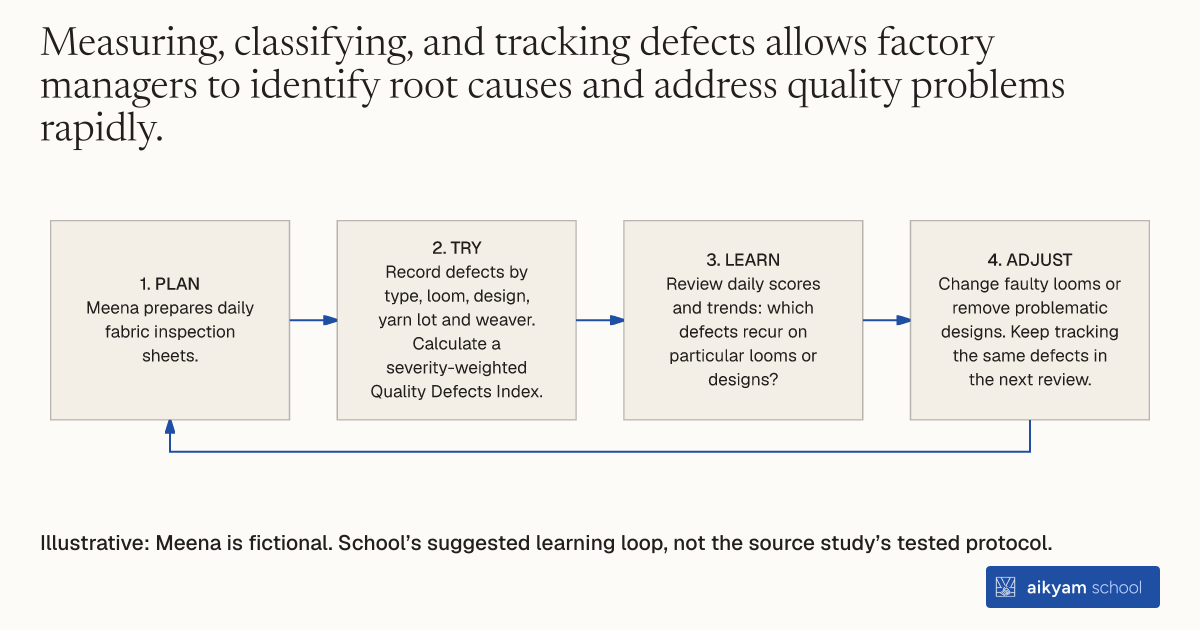
- Plan: Meena prepares daily fabric inspection sheets.
- Try: Record defects by type, loom, design, yarn lot and weaver. Calculate a severity-weighted Quality Defects Index.
- Learn: Review daily scores and trends: which defects recur on particular looms or designs?
- Adjust: Change faulty looms or remove problematic designs. Keep tracking the same defects in the next review.
Illustrative: Meena is fictional. School’s suggested learning loop, not the source study’s tested protocol.
See source →Observe defect categories, severity-weighted scores and recurring flaws. School suggests this learning loop; it is not the source’s tested procedure.
How
When to use
Textile plants lose fabric value because quality defects occur repeatedly without being recorded by defect type. Plant staff mend fabric errors after weaving rather than tracking quality scores to locate machine or operator faults. This method helps plant directors set up a daily Quality Defects Index to track defect severity and eliminate recurring weaving flaws.
Construct a daily Quality Defects Index and log fabric errors defect-wise to eliminate recurring production flaws.
- Quality checkers inspect fabric rolls and record quality defects on paper floor sheets daily.
- Operations managers categorize logged defects by specific type, loom, design, yarn lot, and weaver.
- Floor supervisors calculate a daily Quality Defects Index score as a severity-weighted average of all recorded defects.
- Plant managers log the daily Quality Defects Index scores onto computerized tracking systems every day.
- Factory directors review defect trends regularly to remove designs with complex stitching or fix faulty looms.
Why it works
Systematically evaluating defect data stops faulty machinery from producing flawed fabric for weeks without detection.
Example
International consultants introduced the Quality Defects Index to treatment plants in Indian cotton textile firms, helping plant managers record defects by type and track daily scores.
About the study
Participants
28 plants across 17 large, family-owned cotton textile weaving firms in Tarapur and Umbergaon near Mumbai, India, averaging 273 employees and $7.45 million in annual sales per firm.
Study Design
Randomized controlled trial providing 11 treatment firms with 5 months of management consulting and 6 control firms with 1 month of diagnostic consulting, measuring quality weekly across ~100 weeks.
Results
Adopting Quality Defects Index tracking and defect-wise logging reduced quality defects by 43.1% (p = 0.001) in treatment plants, while increasing defect-wise recording adoption from 28.6% to 92.9% (a 64.3 percentage point increase).