Research procedure
Measure household social contributions
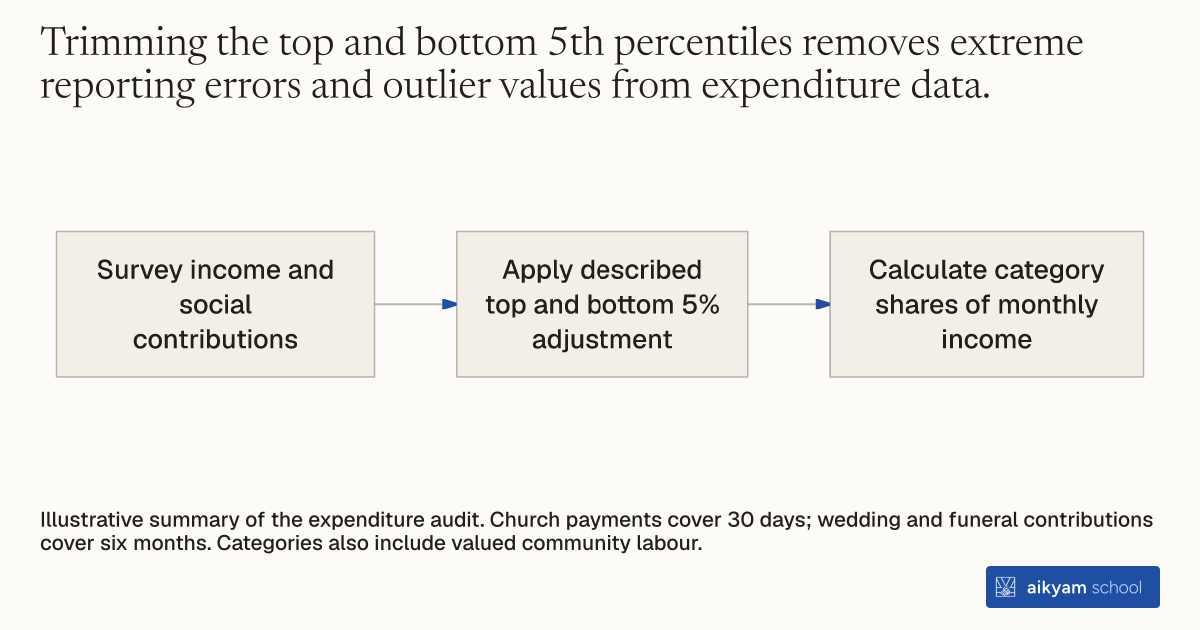
- Survey income and social contributions
- Apply described top and bottom 5% adjustment
- Calculate category shares of monthly income
Illustrative summary of the expenditure audit. Church payments cover 30 days; wedding and funeral contributions cover six months. Categories also include valued community labour.
See source →How
When to use
In many developing urban settings, informal social institutions require citizens to make routine financial and in-kind contributions for community welfare, church tithing, and social events. Researchers and policymakers often lack precise empirical estimates of the economic burden these informal social obligations impose on household budgets. Applying winsorized survey expenditure audits across key categories allows teams to quantify social extraction relative to household income without outlier distortion.
Quantify the financial burden of informal social obligations by conducting winsorized survey audits of household expenditures across key social categories.
- Administer household survey modules eliciting monthly income and expenditures on church offerings, wedding and funeral contributions, and informal civic labor taxes as described in Section 3.2.1.
- Record specific financial outlays for church tithing made during the preceding 30 days.
- Record household contributions given to others for weddings and funerals during the preceding six months.
- Calculate the financial value of informal labor taxes, such as community infrastructure maintenance.
- Winsorize each measure of expenditure and income by trimming the top and bottom 5th percentiles to eliminate extreme outlier distortions as noted in Section 3.2.1.
- Calculate the proportion of winsorized monthly income spent on each social category and total combined social obligations.
Why it works
This produces a reliable, conservative measure of the financial extraction citizens face from informal social institutions.
Example
Researchers audited household expenditures in Kananga, DRC, finding that winsorized payments for church, weddings, funerals, and informal labor taxes totaled 11.5 percent of citizens' monthly income.
About the study
Participants
4,343 randomly sampled households across 364 neighborhoods in Kananga, Democratic Republic of Congo, with 483 eligible households in the main analysis sample.
Study Design
Survey expenditure audit with winsorized data processing (trimming top and bottom 5th percentiles) conducted prior to a randomized land titling field trial.
Results
Social obligations amounted to 11.5 percent of monthly income, comprising 6.2 percent for church payments, 3.7 percent for informal labor tax (salongo), and 1.6 percent for weddings and funerals.