Research procedure
Sample households along a village walk
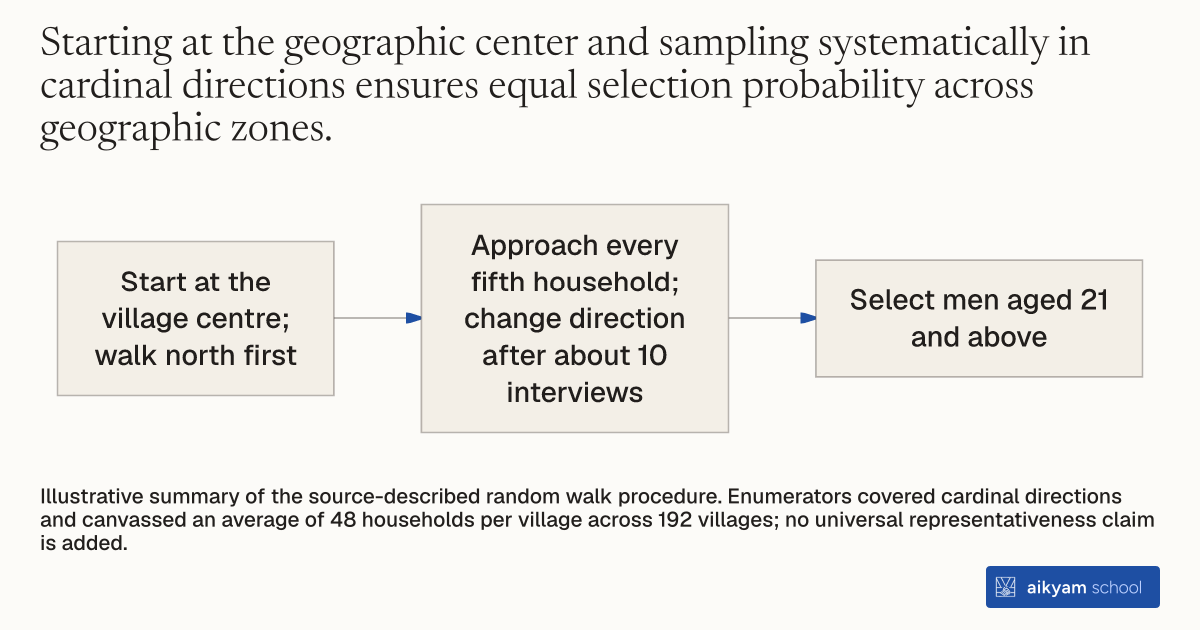
- Start at the village centre; walk north first
- Approach every fifth household; change direction after about 10 interviews
- Select men aged 21 and above
Illustrative summary of the source-described random walk procedure. Enumerators covered cardinal directions and canvassed an average of 48 households per village across 192 villages; no universal representativeness claim is added.
See source →How
When to use
Official household rosters or mapping data are often unavailable in rural developing regions. Research teams need an unbiased sampling method to select representative individuals across local communities. This procedure provides a systematic way to sample average eligible citizens across villages for field studies and candidate recruitment drives.
Select a representative sample of male household respondents across rural villages using a structured random walk protocol.
- Identify a prominent central landmark at the geographic center of the village as the starting point.
- Walk outward from the center in cardinal directions starting with North.
- Approach every 5th household along the walking route to request participation.
- Interview approximately 10 households in one direction before switching to another cardinal direction.
- Select eligible adult male respondents aged 21 and above within approached households.
- Canvass an average of 48 households per village across all cardinal directions until reaching target sample size.
Why it works
This avoids convenience sampling bias in villages lacking formal census maps or address directories.
Example
In Haripur and Abbottabad districts of Pakistan, enumerator pairs used a random walk protocol starting at village centers across 192 villages. They approached every 5th household across cardinal directions, successfully recruiting a balanced experimental sample of 9,310 male citizens with a contact rate exceeding 95 percent.
About the study
Participants
9,310 male citizens across 192 villages in Haripur and Abbottabad districts, Khyber Pakhtunkhwa province, Pakistan.
Study Design
A randomized field experiment utilizing random walk sampling at the village center to select an average of 48 households per village across 12 geographic blocks.
Results
The random walk sampling achieved a contact rate above 95 percent across approached households, yielding an experimental sample balanced on observable individual characteristics across treatment arms.