Research steps
Select households along a mapped route
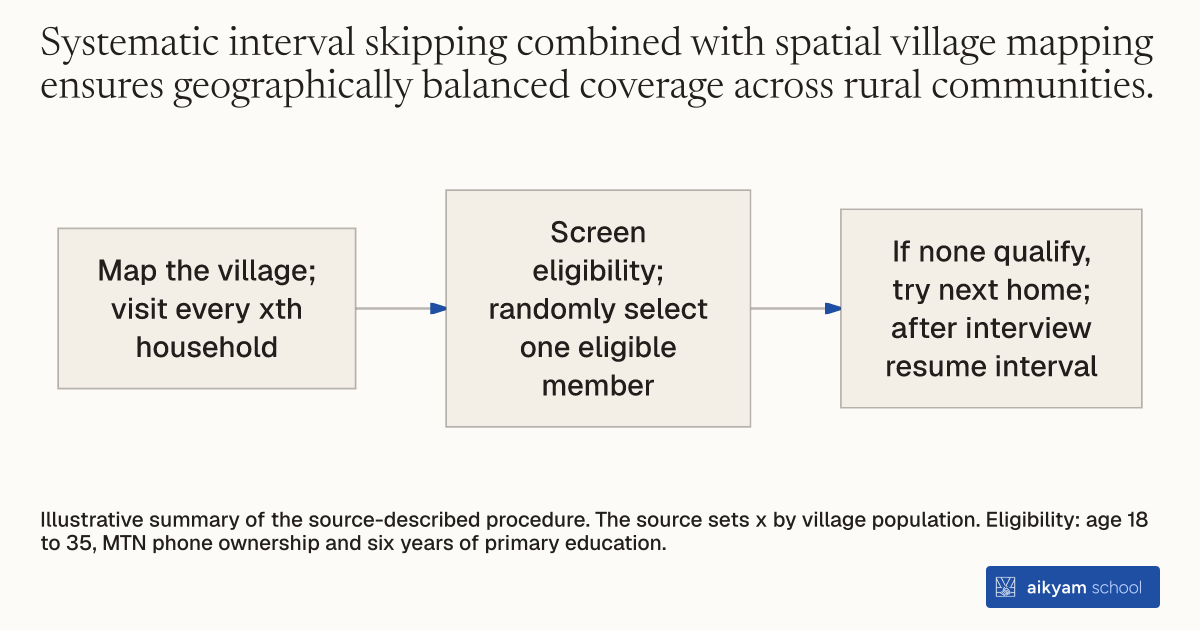
- Map the village; visit every xth household
- Screen eligibility; randomly select one eligible member
- If none qualify, try next home; after interview resume interval
Illustrative summary of the source-described procedure. The source sets x by village population. Eligibility: age 18 to 35, MTN phone ownership and six years of primary education.
See source →How
When to use
Evaluating rural communities often requires selecting representative household samples without existing official population registries. Unbiased household selection prevents enumerator sampling bias in field surveys. This method uses structured geographic random walks and systematic interval skipping to recruit representative survey participants.
Select representative survey respondents across rural villages using a systematic random walk sampling protocol.
- Field teams draw detailed maps of each sample village to mark boundaries and key structures.
- Field enumerators visit every xth household along a predetermined walk path, where x depends on total village population.
- Enumerators screen visited households for eligibility criteria including age 18 to 35, MTN mobile phone ownership, and six years of primary education.
- Survey staff randomly select one eligible individual from the household roster if multiple eligible members reside there.
- Enumerators proceed immediately to the next neighboring household if the selected household lacks an eligible participant.
- Field workers continue to the next xth household along the walk path after identifying and interviewing an eligible respondent.
Why it works
Random selection from household rosters prevents enumerators from handpicking accessible or friendly respondents.
Example
Research enumerators applied random walk sampling across 60 villages in central Uganda to select 1,791 respondents at baseline and 2,424 respondents at follow-up.
About the study
Participants
2,424 adults aged 18 to 35 with at least six years of primary education in 60 villages across Masaka, Mpigi, Mityana, and Mubende districts in central Uganda.
Study Design
Clustered encouragement-design randomized trial using random walk household sampling at baseline (1,791 respondents) and endline (2,424 respondents).
Results
Over 80% of sampled respondents could read without difficulty, 71% owned a personal mobile phone, and demographic variables were balanced between treatment and control groups.