Research procedure
Select households along a right-hand route
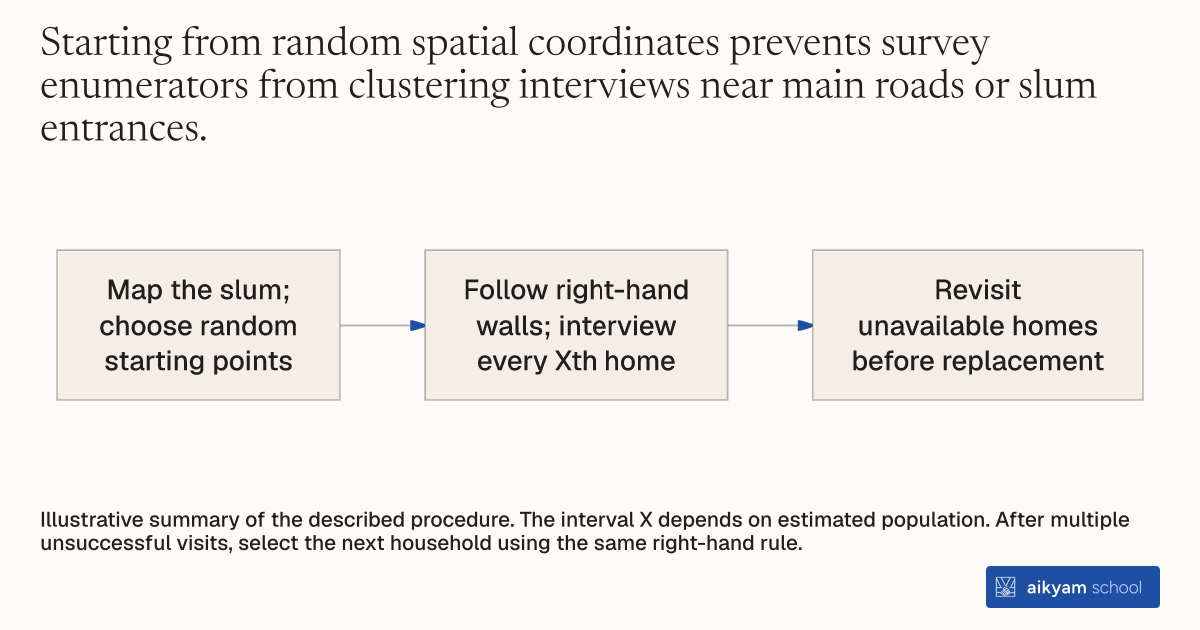
- Map the slum; choose random starting points
- Follow right-hand walls; interview every Xth home
- Revisit unavailable homes before replacement
Illustrative summary of the described procedure. The interval X depends on estimated population. After multiple unsuccessful visits, select the next household using the same right-hand rule.
See source →How
When to use
In dense urban slums lacking official census registers, selecting representative households is difficult. Unmapped lanes and irregular housing clusters make simple random sampling unfeasible without complete rosters. Applying a spatial right-hand rule movement protocol enables survey enumerators to select households systematically across informal slum settlements.
Select slum households along a spatial trajectory starting from randomized points within mapped informal settlements.
- Surveyors draw a comprehensive physical map outlining the boundaries of each target slum settlement.
- Station individual field surveyors at randomly selected starting coordinates across the slum map.
- Instruct each surveyor to move from their assigned starting point along the right-hand side of the wall.
- Calculate a sampling interval X based on the estimated population of the slum.
- Surveyors interview every Xth household encountered along their right-hand route.
- Replace unavailable households by selecting the next household using the same right-hand rule after multiple visits.
Why it works
Traversing systematically along the right-hand wall ensures uniform spatial coverage and eliminates surveyor bias in selecting households.
Example
In Delhi, India, survey enumerators used the right-hand rule across 310 slums in 107 high-slum-density municipal wards. Surveyors completed baseline interviews with 5,481 slum households in April and May 2010, sampling between 9 and 126 households per ward depending on slum size.
About the study
Participants
5,481 slum households across 107 high-slum-density municipal wards in Delhi, India, where 51% of respondents were household heads and 49% were spouses.
Study Design
Spatial field sampling combining slum physical mapping, random starting points within slums, and right-hand wall traversal interviewing every Xth household.
Results
The method successfully sampled 5,481 slum households, establishing that 86% were registered voters, 83% of registered residents voted in the last election, and 70% identified sanitation as a primary problem.