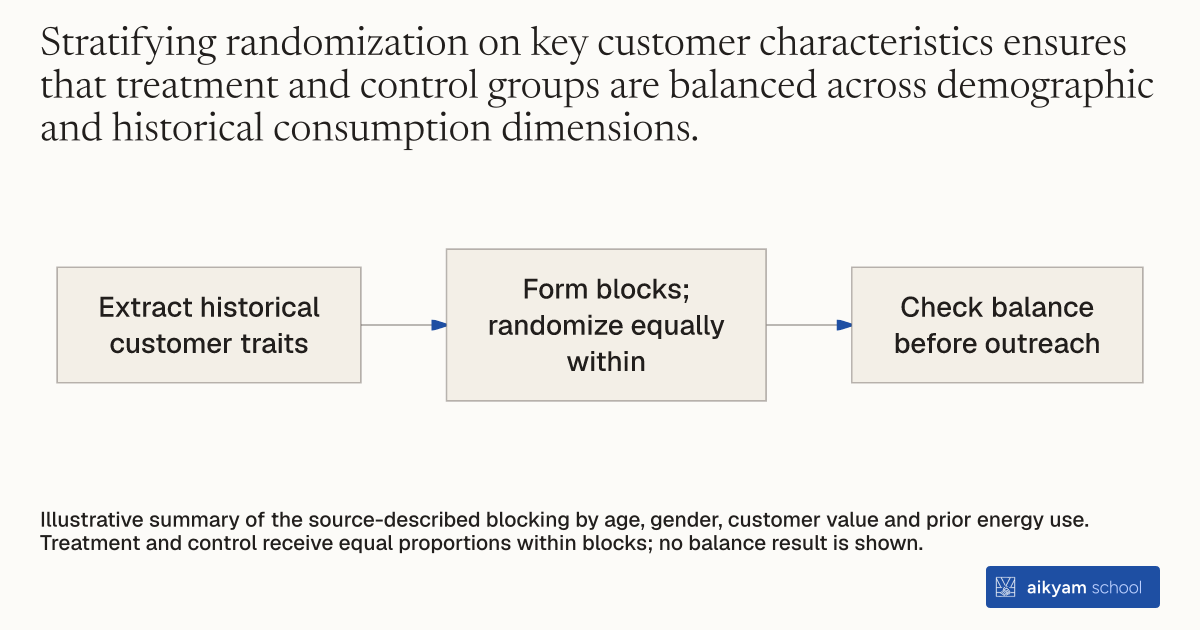
Research steps
Block before random assignment
- Extract historical customer traits
- Form blocks; randomize equally within
- Check balance before outreach
Illustrative summary of the source-described blocking by age, gender, customer value and prior energy use. Treatment and control receive equal proportions within blocks; no balance result is shown.
See source →How
When to use
Unobserved household differences can create baseline imbalances across experimental treatment groups. Stratifying the sample prior to random assignment balances key customer demographic and usage characteristics. This allows evaluators to isolate true pricing and intervention effects.
Block the random assignment of experimental subjects across treatment and control groups using administrative baseline customer characteristics.
- Extract historical account records for all eligible utility customers from administrative databases.
- Identify core demographic and behavioral variables, including customer age, gender, customer value, and prior energy consumption levels.
- Group customer accounts into stratified blocks based on combinations of these historical characteristics.
- Randomly assign households within each stratified block in equal proportions to treatment and control groups.
- Verify baseline covariate balance across treatment arms before launching the outreach campaign.
Why it works
This prevents baseline differences from confounding the measured impact of experimental incentives.
Example
British Gas researchers extracted baseline account data for 26,025 eligible utility customers in the United Kingdom and blocked randomization across control, £5, and £10 incentive groups on age, gender, customer value, and historical usage, resulting in identical baseline age (57.5 to 57.7 years) and gender (49.3% male) across all three groups.
About the study
Participants
26,025 residential British Gas customers in the United Kingdom across control (N=8,668), £5 incentive (N=8,677), and £10 incentive (N=8,680) groups with an average age of 57.5 to 57.7 years and 49.3% male.
Study Design
Stratified randomized field experiment blocking treatment assignment on baseline customer age, gender, customer value, and historical energy consumption.
Results
Randomization blocking produced balanced treatment arms with average age matching across groups (57.6 years in control, 57.5 years in £5, 57.7 years in £10) and identical proportion male (49.3% across all three groups).