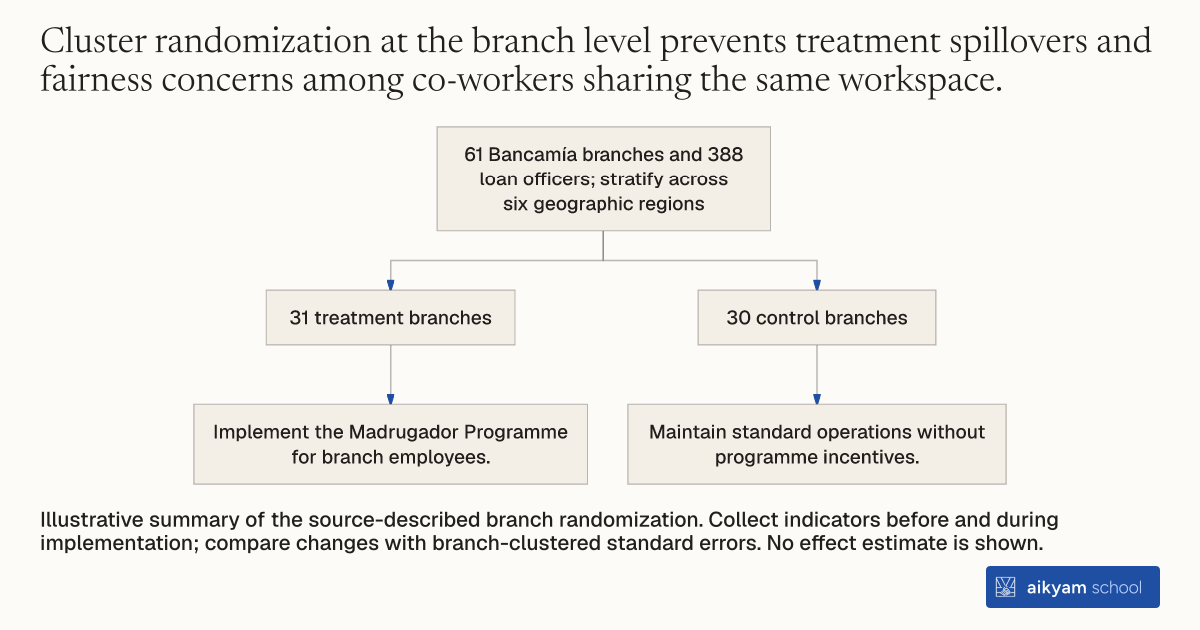
Research allocation
Randomize branches within geographic regions
61 Bancamía branches and 388 loan officers; stratify across six geographic regions
- 31 treatment branches
- Implement the Madrugador Programme for branch employees.
- 30 control branches
- Maintain standard operations without programme incentives.
Illustrative summary of the source-described branch randomization. Collect indicators before and during implementation; compare changes with branch-clustered standard errors. No effect estimate is shown.
See source →How
When to use
Organizations implementing multi-branch workplace interventions need to evaluate program impact without generating internal friction or contamination among workers in the same office. Stratifying and randomizing intact operational units ensures balanced treatment and control groups across diverse geographic and economic environments. This method helps researchers and evaluators measure organizational programs accurately across geographically distributed branches.
Randomize intact operational units into treatment and control groups after stratifying by geographic region to evaluate workplace interventions cleanly.
- Researchers group all participating organization branches into distinct geographic regions to account for regional economic differences.
- Evaluators stratify branches within each geographic region based on location characteristics and operational history.
- Researchers randomly assign half of the branches within each geographic stratum to the treatment group and the remaining half to the control group.
- Program administrators implement the intervention across all employees working within treatment branches while control branches maintain standard operations.
- Analysts collect operational indicators from all branches before and during the intervention to run difference-in-differences evaluations.
Why it works
Stratifying by geographic region ensures treatment and control groups remain balanced across different local economic conditions.
Example
In Colombia, researchers stratified 61 Bancamía branches across six geographic regions, including Northern Bogotá, Southern Bogotá, Cundinamarca/Boyacá, Northern Medellín, Southern Medellín, and Antioquia/Caldas. They randomly assigned 31 branches to receive the Madrugador Program and 30 branches to serve as controls, maintaining statistically identical baseline portfolio sizes and delinquency rates across both groups.
About the study
Participants
61 bank branches (31 treatment, 30 control) and 388 loan officers across Colombia.
Study Design
Stratified cluster-randomized trial evaluating administrative data and survey responses from July 2008 to April 2009 using difference-in-differences regressions with branch-level clustering.
Results
Geographic stratification and cluster randomization produced treatment and control groups with no statistically significant baseline differences in branch age (56.5 vs 39.3 months, p = 0.21), portfolio size ($2.88M vs $2.61M, p = 0.34), or delinquency rates (11.0% vs 11.1%, p = 0.88).