Research procedure
Sample villages, then households
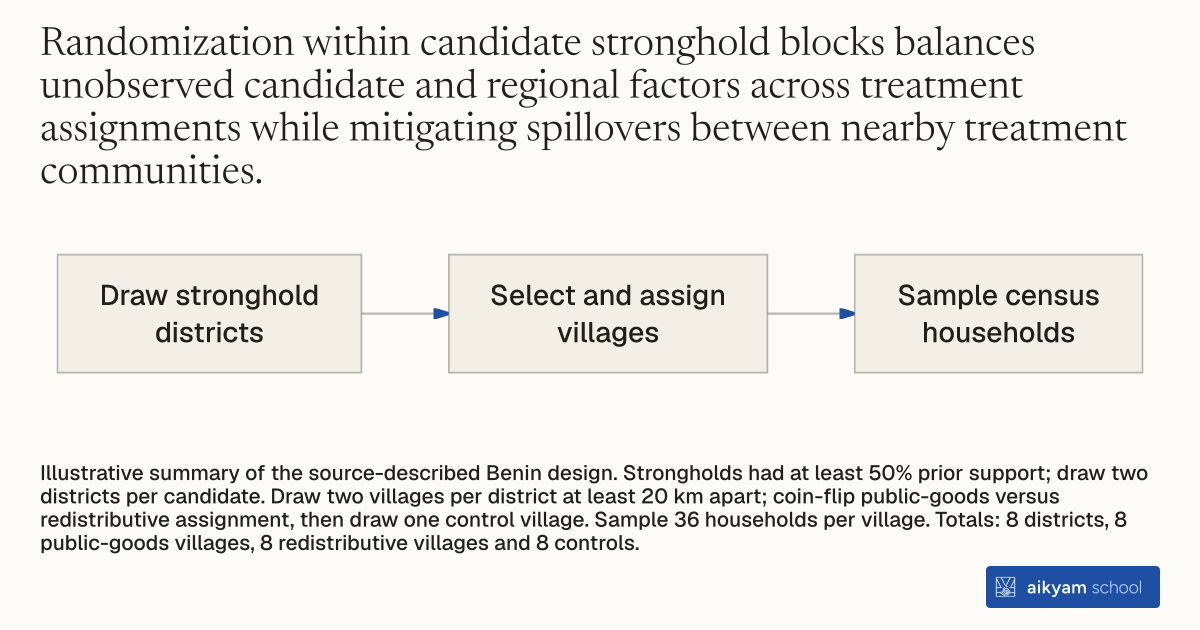
- Draw stronghold districts
- Select and assign villages
- Sample census households
Illustrative summary of the source-described Benin design. Strongholds had at least 50% prior support; draw two districts per candidate. Draw two villages per district at least 20 km apart; coin-flip public-goods versus redistributive assignment, then draw one control village. Sample 36 households per village. Totals: 8 districts, 8 public-goods villages, 8 redistributive villages and 8 controls.
See source →How
When to use
Researchers and evaluators conducting field experiments or surveys in political economy need unbiased sample selection across geographic units while controlling for unobserved candidate or district characteristics. Standard random sampling across an entire nation risks contamination across nearby communities or imbalance across candidate strongholds. This method applies to multi-site randomized evaluations and field experiments studying electoral campaigns, public service delivery, or voter behavior in rural developing contexts.
Select experimental treatment and control villages and sample survey households using a multi-stage randomized block design across political candidate strongholds.
- Research staff identify candidate stronghold electoral districts where a participating party gained at least 50 percent of votes in prior presidential elections.
- Field coordinators randomly draw two stronghold districts per candidate from each candidate's list of strongholds.
- Field teams randomly draw two villages per district from the full list of candidate villages, re-drawing any second village located less than 20 kilometres away.
- Field managers flip a coin for each pair of selected villages to assign one to the public goods campaign treatment and one to the redistributive treatment.
- Survey staff randomly pick one control village per district from unassigned comparison villages to serve as the baseline group.
- Survey teams randomly sample 36 households per village from the national census list and interview every voting adult present in each sampled household.
Why it works
Clustered household sampling from national census lists ensures representative voter coverage across treatment and control sites.
Example
In Benin during the March 2001 presidential election, researchers applied a three-stage randomized block cluster design across 8 electoral districts representing candidate strongholds, selecting 16 treatment villages (8 public goods, 8 clientelist) and 8 control villages, followed by random household sampling of 36 households per village for post-election surveying.
About the study
Participants
2,534 voting-age adults surveyed across 24 villages (16 treatment and 8 control) in 8 electoral districts in Benin, with 36 households randomly sampled per village from 2002 national census lists.
Study Design
Three-stage randomized block cluster sampling design (randomized selection of 8 stronghold electoral districts, randomized selection of villages spaced at least 20 km apart, coin-flip treatment assignment, and household census sampling) evaluated with village-clustered standard errors.
Results
Achieved an average household response rate of 30.7 households per village (85.4 percent) and an average of 3.17 respondents per household (standard deviation 1.36) across 2,534 interviewed individuals.