Research tracking
Follow both household groups over ten years
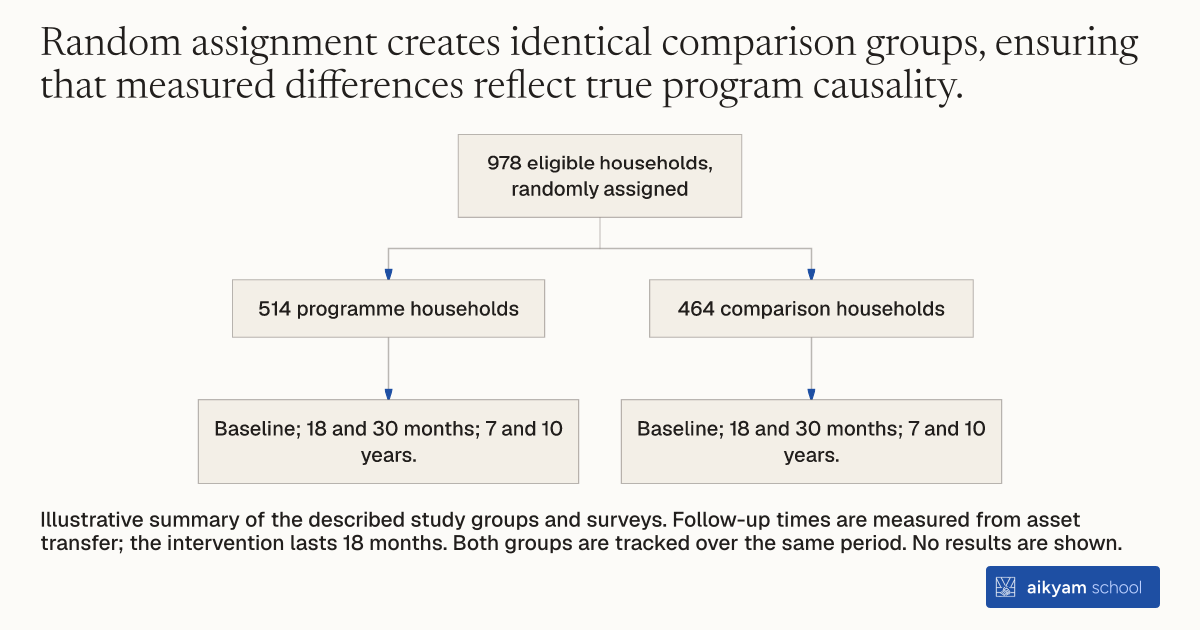
978 eligible households, randomly assigned
- 514 programme households
- Baseline; 18 and 30 months; 7 and 10 years.
- 464 comparison households
- Baseline; 18 and 30 months; 7 and 10 years.
Illustrative summary of the described study groups and surveys. Follow-up times are measured from asset transfer; the intervention lasts 18 months. Both groups are tracked over the same period. No results are shown.
See source →How
When to use
Development organizations and researchers need rigorous evidence on whether complex poverty interventions create lasting benefits. Standard short-term evaluations miss long-run economic shifts, such as household income diversification. Program teams use randomized evaluations with multi-wave survey tracking to measure impacts across extended time horizons up to ten years.
Execute a randomized evaluation combined with longitudinal survey tracking across multiple waves to evaluate long-term program impact.
- Select a sample of eligible ultra-poor households across targeted rural villages.
- Randomly assign participant households to a treatment group receiving the program package or a comparison group.
- Administer a baseline survey prior to program rollout to document initial socioeconomic conditions.
- Conduct an endline survey immediately after the 18-month intervention concludes.
- Carry out follow-up survey waves at 30 months, seven years, and ten years post-transfer to track long-run outcomes.
Why it works
Longitudinal tracking across multiple waves reveals whether initial gains decay over time or compound through non-farm business growth and labor diversification.
Example
In West Bengal, India, researchers partnered with Bandhan to evaluate the Graduation program using a randomized evaluation with 978 households (514 treatment and 464 comparison). Five survey waves conducted over ten years proved that initial livestock transfers created persistent increases in monthly consumption, food security, and earnings.
About the study
Participants
978 ultra-poor households in Murshidabad, West Bengal, India, with 514 assigned to treatment and 464 to comparison.
Study Design
Randomized controlled trial tracking treatment and comparison households across five survey waves over ten years (baseline, 18 months, 30 months, 7 years, and 10 years).
Results
Ten years after asset transfer, program participants maintained significantly higher consumption and earnings, generating a total program benefit-cost ratio of 379 percent over ten years.