Try, learn and adjust
Check household targeting before enrolment
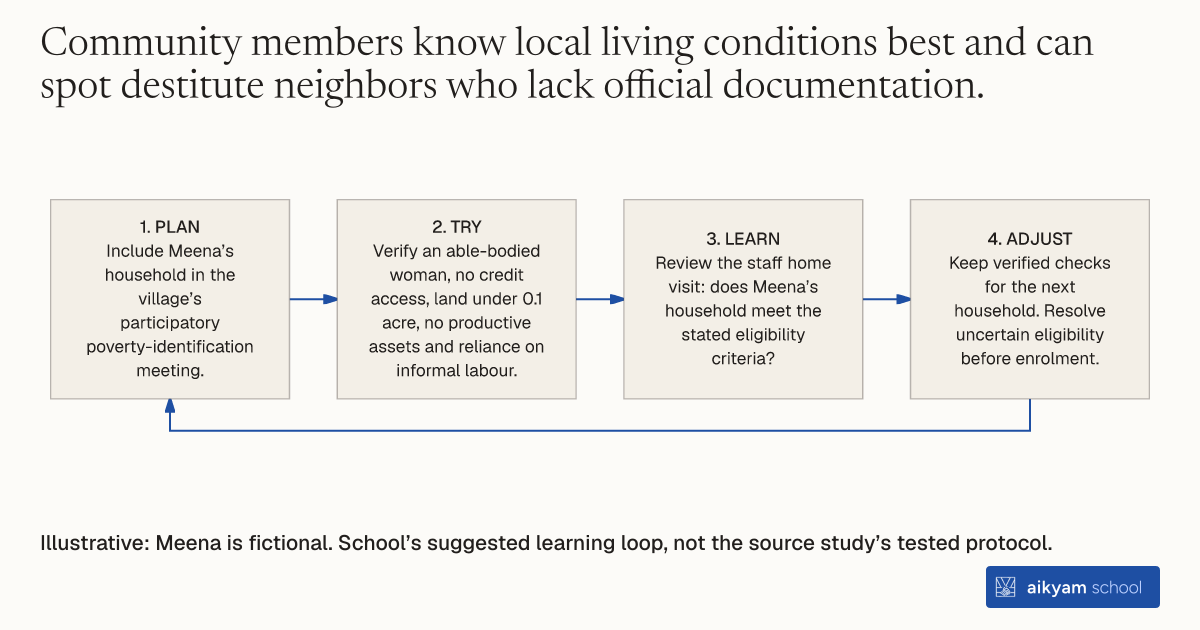
- Plan: Include Meena’s household in the village’s participatory poverty-identification meeting.
- Try: Verify an able-bodied woman, no credit access, land under 0.1 acre, no productive assets and reliance on informal labour.
- Learn: Review the staff home visit: does Meena’s household meet the stated eligibility criteria?
- Adjust: Keep verified checks for the next household. Resolve uncertain eligibility before enrolment.
Illustrative: Meena is fictional. School’s suggested learning loop, not the source study’s tested protocol.
See source →School’s suggested, untested loop. Observe community identification and staff verification; eligibility alone does not assign treatment.
How
When to use
Extremely poor rural households face severe barriers to earning decent income. Standard poverty programs often miss the destitute because formal records fail to identify them. Program teams use this method to identify ultra-poor households with an able-bodied woman, no credit access, and minimal assets.
Identify ultra-poor households through community meetings and follow-up staff verification visits in target villages.
- Hold a participatory village meeting where community members collectively identify households living in extreme poverty.
- Filter the list to select households that have an able-bodied woman present.
- Exclude households that have access to credit.
- Verify that candidate households meet criteria including holding small land under 0.1 acre, having no productive assets, and relying on informal labor for income.
- Send organization staff to conduct a verification visit at each candidate home to confirm eligibility.
Why it works
Independent staff verification ensures that selected households strictly meet all poverty criteria before enrolling in the program.
Example
In West Bengal, India, Bandhan identified ultra-poor households in rural villages using a participatory meeting followed by staff verification visits. Out of 978 identified eligible households consuming an average of 40 US dollars per month and owning less than 0.1 acre of land, researchers assigned 514 households to receive the 18-month Graduation program.
About the study
Participants
978 ultra-poor households in Murshidabad, West Bengal, India, consuming 40 US dollars per month on average and owning less than 0.1 acre of land.
Study Design
Randomized controlled trial evaluating 514 treatment households and 464 comparison households tracked over ten years across multiple survey waves.
Results
Targeted households consumed 40 US dollars per month on average, with 90 percent of adults and 40 percent of children skipping meals prior to intervention.