Research design
Compare crisis support groups
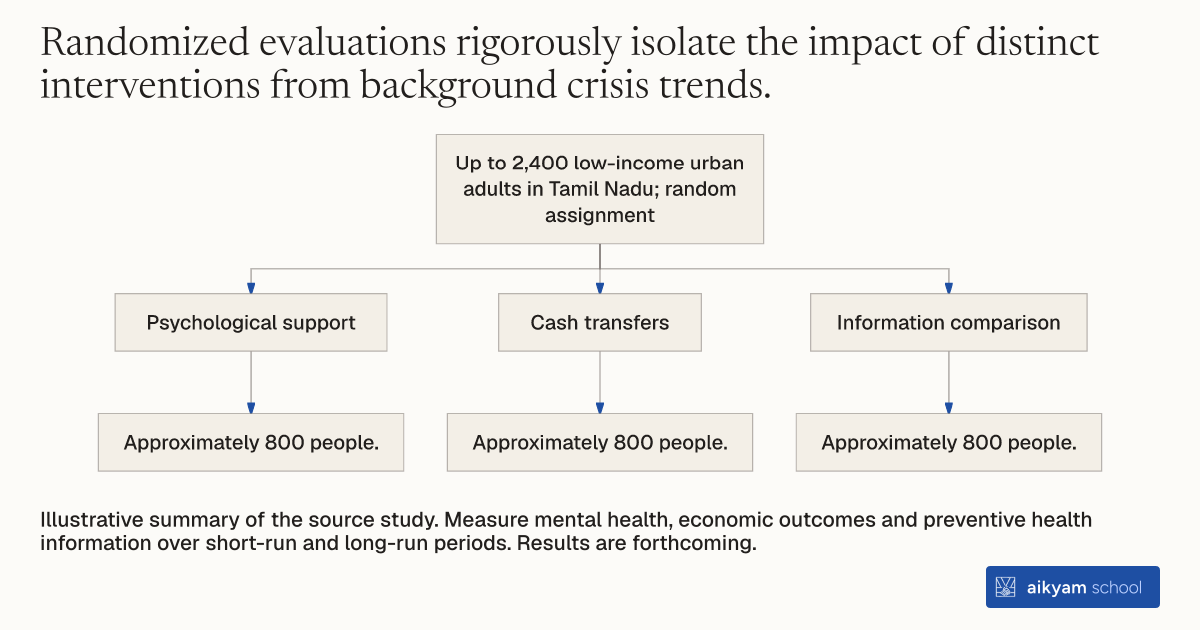
Up to 2,400 low-income urban adults in Tamil Nadu; random assignment
- Psychological support
- Approximately 800 people.
- Cash transfers
- Approximately 800 people.
- Information comparison
- Approximately 800 people.
Illustrative summary of the source study. Measure mental health, economic outcomes and preventive health information over short-run and long-run periods. Results are forthcoming.
See source →How
When to use
Low-income communities during health crises experience severe economic strain alongside mental health challenges. Decision-makers lack evidence on whether light-touch psychological support or cash transfers improve well-being and resilience. A randomized evaluation measures the short-run and long-run impacts of these crisis interventions on affected populations.
Evaluate crisis interventions by measuring short-run and long-run mental health, economic, and preventive health outcomes among target participants.
- Researchers randomly assign participants into intervention and comparison groups of approximately 800 people each.
- Field staff measure participants' mental health levels, tracking experiences of depression, anxiety, loneliness, and stress.
- Surveyors collect detailed economic data on food consumption, hunger levels, labor supply, earnings, and household debt.
- Data collectors assess participants' ability to absorb and retain relevant health information regarding Covid-19 prevention behaviors.
- Evaluators compare outcomes across intervention and comparison groups over short-run and long-run time horizons.
Why it works
Tracking both economic and psychological metrics reveals whether mental health support or cash transfers better foster overall resilience.
Example
Researchers from J-PAL South Asia and SCARF India conducted a randomized evaluation tracking mental health and economic outcomes among up to 2,400 low-income urban adults in Tamil Nadu, India.
About the study
Participants
Up to 2,400 urban low-income adults divided into three groups of approximately 800 people in Tamil Nadu, India.
Study Design
Randomized evaluation comparing psychological support, cash transfers, and an information comparison group across short-run and long-run outcomes.
Results
Research ongoing; results are forthcoming.