Research description
Describe rotating council reservations
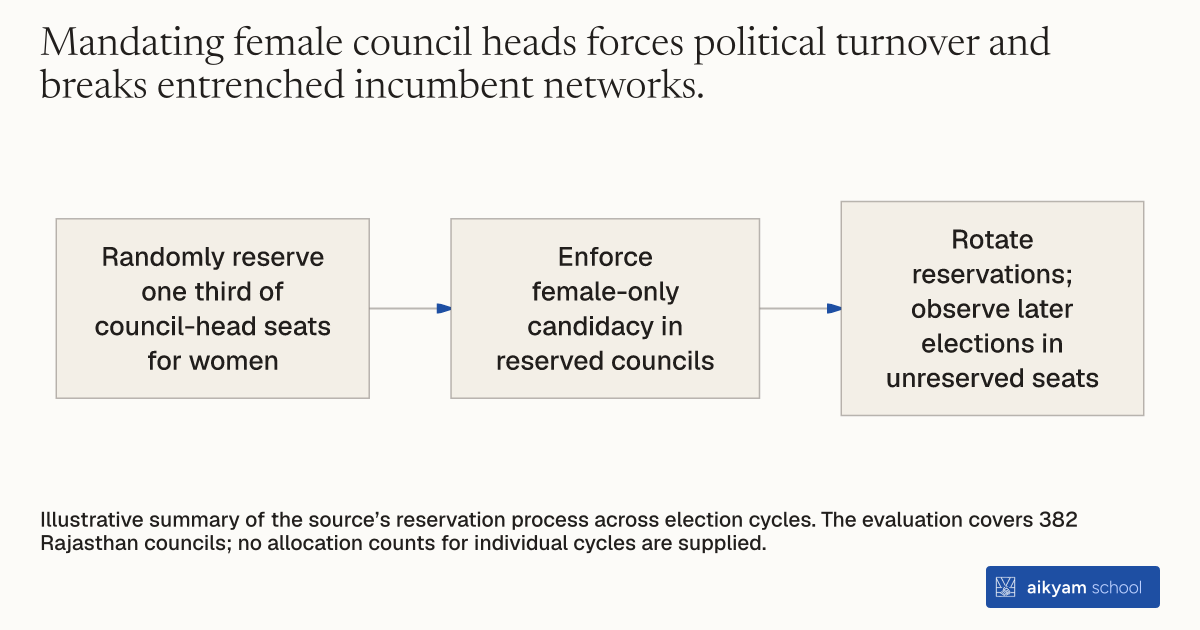
- Randomly reserve one third of council-head seats for women
- Enforce female-only candidacy in reserved councils
- Rotate reservations; observe later elections in unreserved seats
Illustrative summary of the source’s reservation process across election cycles. The evaluation covers 382 Rajasthan councils; no allocation counts for individual cycles are supplied.
See source →How
When to use
In many democracies, incumbent politicians and political elites maintain long-standing control over local governance, raising entry barriers for new candidates. Women face social barriers that limit their political participation unless reservations mandate female leadership. This method uses constitutionally mandated randomized gender quotas across election cycles to break incumbent power and open local council positions to new leadership.
Reserve a fixed proportion of local council leadership positions exclusively for women through random assignment across successive election cycles.
- State election authorities establish a legal requirement reserving one third of head councilor positions for female candidates.
- Electoral commissions randomly assign village councils to be reserved for women prior to each local election cycle.
- Local election officials enforce the reservation rule so that only female candidates can contest the head councilor seat in selected councils during that cycle.
- Rotate the random reservation assignments across village councils in subsequent election cycles so that previously reserved seats return to unreserved status.
- Permit all eligible citizens of any gender to run in unreserved seats during following elections while removing the artificial incumbency advantage of previously forced leaders.
Why it works
When reservations end, female incumbents often face social pressure not to re-run, which lowers entry costs and enables new candidates to seek election.
Example
In Rajasthan, India, the state government constitutionally mandated that one third of Sarpanch seats across village councils be randomly reserved for women in prior election cycles. In the 2010 elections, when previously reserved councils became unreserved, candidate entry increased by one additional candidate above the average of seven candidates. Poorly performing incumbents in previously reserved councils were 34 percent less likely to run for reelection.
About the study
Participants
382 village councils representing rural populations in Rajasthan, India.
Study Design
Randomized evaluation exploiting the random assignment of women reservations across election cycles to measure candidate entry, election outcomes, and post-election government performance.
Results
Past reservations for women led to a 48 percent increase in the probability of women running for office. In non-reserved seats that were previously reserved, candidate entry increased by one candidate over the average of seven candidates. Incumbents performing one standard deviation below the mean in implementing MGNREGA were 34 percent less likely to re-run in previously reserved councils.