Research design
Randomise an option to upgrade work
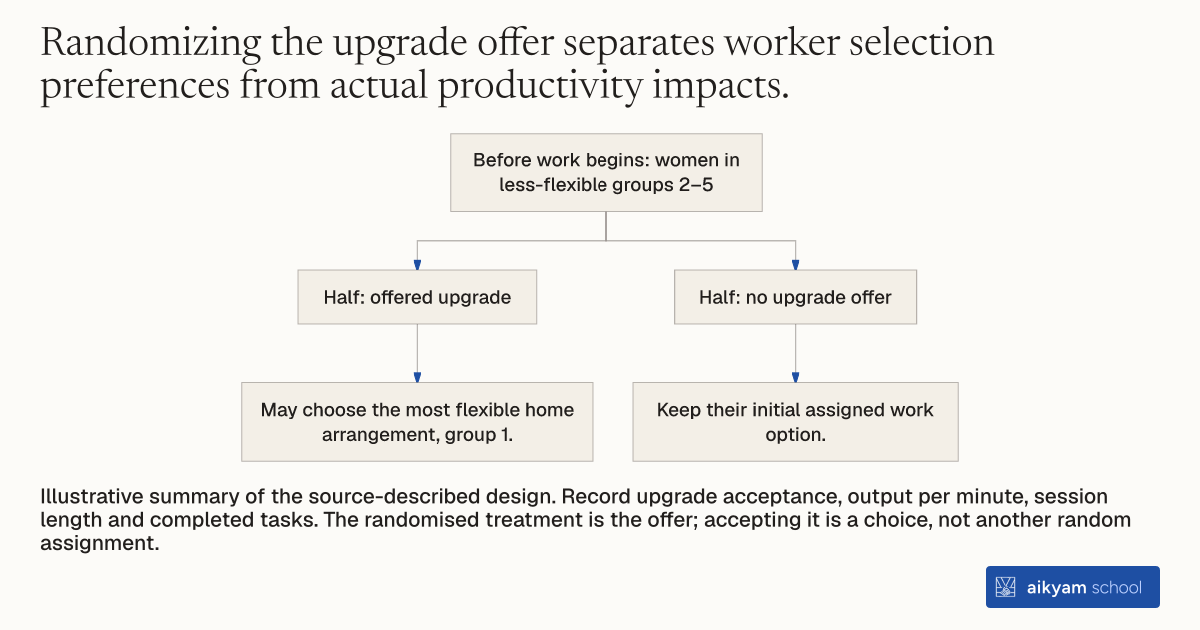
Before work begins: women in less-flexible groups 2–5
- Half: offered upgrade
- May choose the most flexible home arrangement, group 1.
- Half: no upgrade offer
- Keep their initial assigned work option.
Illustrative summary of the source-described design. Record upgrade acceptance, output per minute, session length and completed tasks. The randomised treatment is the offer; accepting it is a choice, not another random assignment.
See source →How
When to use
Program designers often need to evaluate how offering greater workplace flexibility changes worker productivity and participation. Randomly offering job upgrades to workers in less flexible roles solves this challenge by isolating selection effects from direct performance changes. This method serves evaluators and employers measuring the true trade-offs of flexible work arrangements.
Offer a randomized option to switch from less flexible job roles to fully flexible home-based positions before work begins.
- Assign participants initially to less flexible work arrangements such as office roles or fixed timeslots.
- Select half of the participants in less flexible groups at random to receive a job upgrade offer.
- Present selected participants with the option to switch to the most flexible home-based arrangement.
- Record acceptance rates for the upgrade offer among selected participants.
- Track output per minute, work session length, and total task completion across upgraded and non-upgraded workers.
Why it works
Comparing upgraded workers with non-upgraded peers reveals how domestic environments affect output.
Example
In Kolkata, West Bengal, India, researchers randomly offered half the women in less flexible work groups the option to upgrade to fully flexible home work, finding that women who accepted the upgrade produced 19 percent less per minute due to shorter work sessions caused by home interruptions.
About the study
Participants
Half of the women in groups 2 through 5 (from a total sample of 1,670 women; average age 30, 93% married) in Kolkata, West Bengal, India.
Study Design
Randomized controlled trial evaluation offering a pre-work job upgrade from less flexible groups (groups 2-5) to the most flexible arrangement (group 1) to measure productivity and selection.
Results
Women who started with an office job and accepted the upgrade to work flexibly produced 19 percent less per minute and had 10-minute shorter work sessions compared to women not selected for the upgrade.