Research design
Randomise seed mini-kit distribution
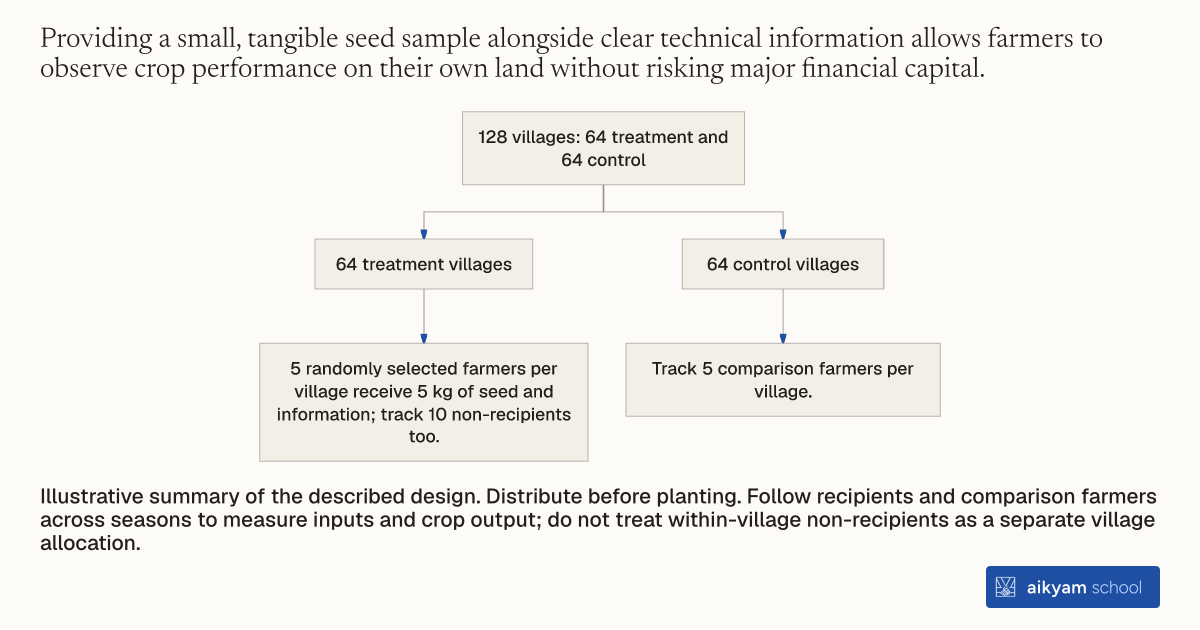
128 villages: 64 treatment and 64 control
- 64 treatment villages
- 5 randomly selected farmers per village receive 5 kg of seed and information; track 10 non-recipients too.
- 64 control villages
- Track 5 comparison farmers per village.
Illustrative summary of the described design. Distribute before planting. Follow recipients and comparison farmers across seasons to measure inputs and crop output; do not treat within-village non-recipients as a separate village allocation.
See source →How
When to use
Distributing new agricultural technologies to smallholder farmers in risk-prone regions requires evaluating both direct adoption and behavioral shifts. Traditional extension programs often lack structured testing mechanisms to observe input investments alongside crop yields. This method helps agricultural development programs introduce high-performing seed varieties to flood-vulnerable farming communities.
Distribute small seed mini-kits with educational materials directly to randomly selected smallholder farmers at the start of the planting season.
- Project staff identify flood-prone agricultural villages and randomly assign them to treatment and comparison groups.
- Extension staff assemble mini-kits containing a 5 kg bag of improved seed and instructional information on crop traits.
- Field teams distribute one mini-kit to each of 5 randomly selected farmers per treatment village before planting begins.
- Recipient farmers sow the 5 kg seed allocation on their plots using standard cultivation practices.
- Survey teams track recipient farmers and local comparison non-recipients across multiple seasons to measure input decisions and crop output.
Why it works
Eliminating initial trial costs encourages farmers to adopt complementary productive inputs like fertilizer and labor-intensive transplanting.
Example
Researchers partnered with IRRI in Bhadrak and Balasore districts, Odisha, India, distributing 5 kg Swarna-Sub1 mini-kits to 5 farmers in each of 64 treatment villages. Mini-kit recipients increased fertilizer use by 24.6 kg per hectare and expanded cultivated land area by 0.1 hectares compared to non-recipients.
About the study
Participants
128 villages in Bhadrak and Balasore districts, Odisha, India; 64 treatment villages (5 mini-kit recipient farmers and 10 comparison non-recipients per village) and 64 control villages (5 comparison farmers per village); 1,280 smallholders; 56 percent lived below the poverty line.
Study Design
Two-year randomized controlled trial tracking mini-kit recipient households across the 2011–2012 flood season and 2012–2013 non-flood season to measure agricultural investments, credit use, and crop yields.
Results
Receiving a mini-kit increased cultivated land by 0.1 hectares (a 9 to 10 percent increase), fertilizer use by 24.6 kg per hectare (an 11 percent increase), formal credit usage by 6.8 percentage points (a 36 percent increase), and reduced seed broadcasting by 6.3 percentage points.