Research allocation
Allocate within centre-and-trade groups
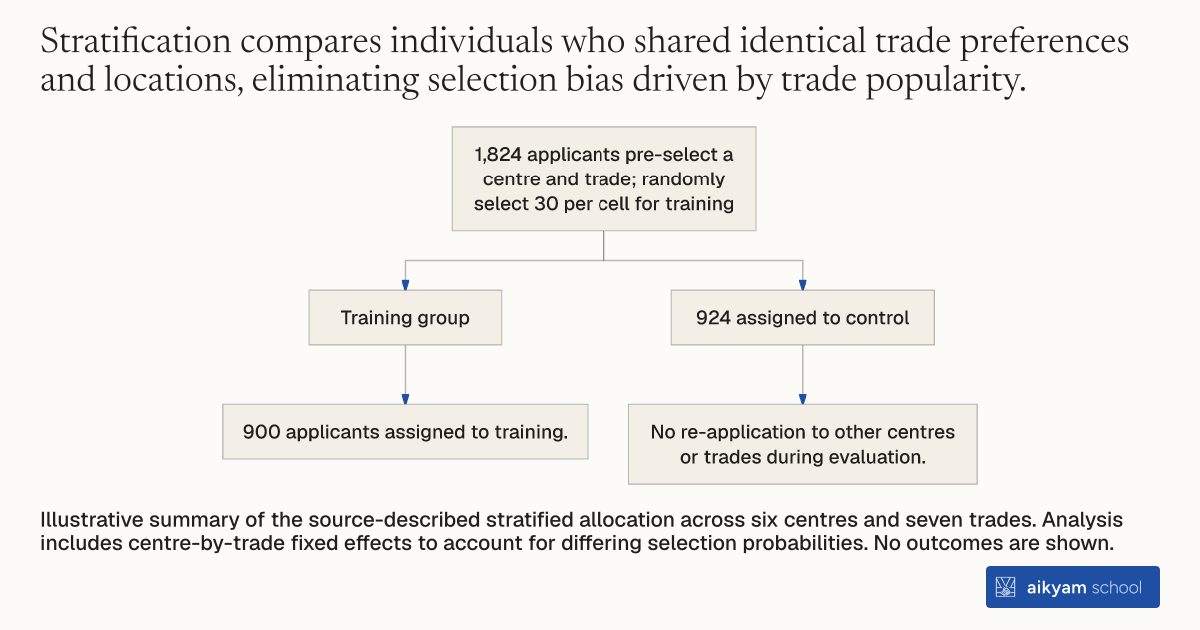
1,824 applicants pre-select a centre and trade; randomly select 30 per cell for training
- Training group
- 900 applicants assigned to training.
- 924 assigned to control
- No re-application to other centres or trades during evaluation.
Illustrative summary of the source-described stratified allocation across six centres and seven trades. Analysis includes centre-by-trade fixed effects to account for differing selection probabilities. No outcomes are shown.
See source →How
When to use
Evaluating social programs with limited training slots across multiple locations and trades poses statistical challenges. Over-subscribed choices lead to uneven selection probabilities that obscure true intervention impacts. Stratifying randomization at the center-and-trade level ensures balanced comparisons among applicants seeking the same technical skill.
Randomly allocate limited program positions among pre-screened applicants within center and trade combinations.
- Instruct eligible applicants to pre-select one training center and one specific technical trade before allocation.
- Group all applicants into distinct strata defined by their chosen center-and-trade combination.
- Determine the exact number of available training slots in each center-trade cell.
- Execute individual randomization within each stratum to assign fixed numbers of applicants to treatment and control status.
- Include center-by-trade stratum fixed effects in outcome regressions to control for differential selection probabilities across trade choices.
- Restrict control group members from re-applying to other trades or centers during the evaluation period.
Why it works
Controlling for stratum fixed effects accounts for varying selection probabilities while isolating the unbiased treatment impact.
Example
In Northern Nigeria, 1,824 eligible youth applied to six skills centers across seven trades, pre-selecting their preferred center-trade combination. Evaluators stratified randomization by center-trade cell, randomly selecting exactly 30 applicants per cell for training (900 total) while assigning 924 applicants to control.
About the study
Participants
1,824 eligible applicants aged 15 to 24 in Kaduna and Katsina states, Northern Nigeria.
Study Design
Stratified randomized controlled trial assigning 900 youth to training and 924 to control within center-trade cells, controlling for stratum fixed effects and estimating intent-to-treat effects at endline 12 months post-training.
Results
High compliance yielded a 73 percent completion rate, boosting the income and employment index by 0.241 standard deviations and the youth gender norms index by 0.120 standard deviations.