Research procedure
Profile entrepreneurs before randomisation
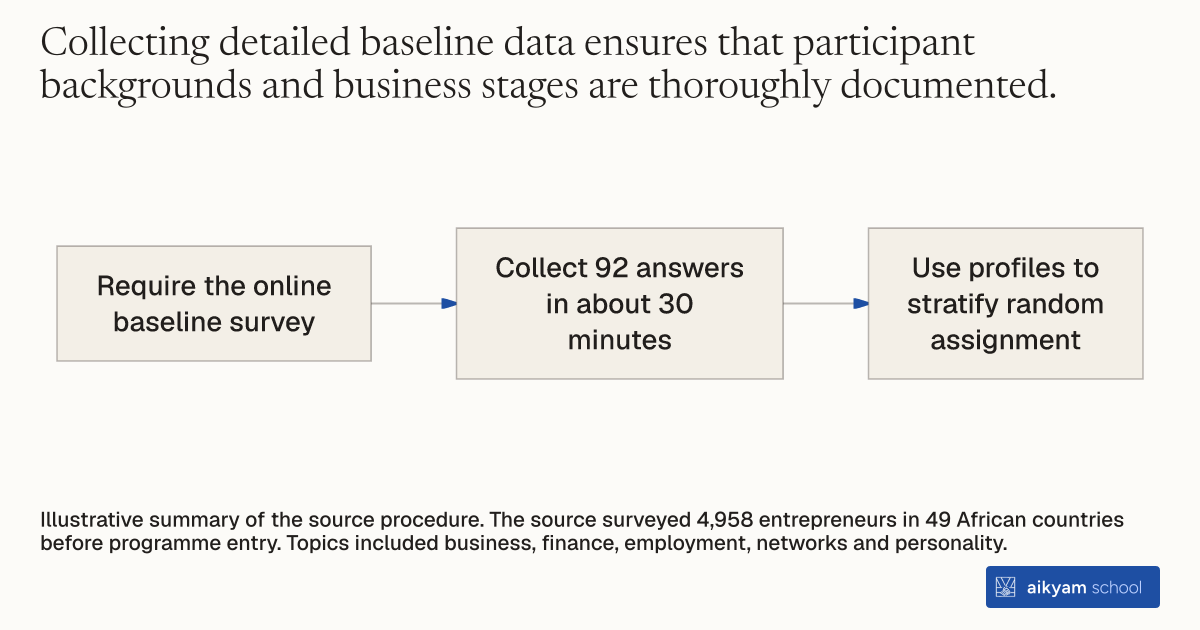
- Require the online baseline survey
- Collect 92 answers in about 30 minutes
- Use profiles to stratify random assignment
Illustrative summary of the source procedure. The source surveyed 4,958 entrepreneurs in 49 African countries before programme entry. Topics included business, finance, employment, networks and personality.
See source →How
When to use
Organizations need to diagnose participant needs and baseline traits before launching an intervention. Program designers often lack comprehensive demographic, financial, and behavioral profiles for aspiring entrepreneurs across diverse regions. Administering an extensive online baseline survey establishes participant backgrounds and enables balanced experimental stratification.
Administer a comprehensive online baseline survey to establish participant profiles prior to program entry and randomization.
- Require all recruited participants to complete an online baseline questionnaire as a mandatory prerequisite for program entry.
- Present 92 standardized questions covering demographics, business profiles, financial access, labor market outcomes, networks, and personality traits.
- Allow approximately 30 minutes for participants to complete the survey form.
- Process survey responses to evaluate baseline business idea quality, prior experience, and risk preferences.
- Use baseline survey indicators to construct balanced stratification blocks for subsequent experimental randomization.
Why it works
This allows program evaluators to stratify randomization accurately and control for baseline individual characteristics during impact analysis.
Example
Program managers administered a 92-question online baseline survey to 4,958 recruited participants across 49 African countries prior to randomization. The survey established that 63% owned an existing business, 82% held a university degree, and 55% were currently employed.
About the study
Participants
4,958 entrepreneurs from 49 African countries; 31% female, average age 30.96 years, 82% completed university, 63% with an existing business.
Study Design
Comprehensive 92-question online baseline survey administered as a prerequisite prior to experimental randomization and stratification across treatment arms.
Results
The survey successfully profiled all 4,958 participants across 92 baseline variables, revealing an average age of 30.96 years, 5.11 years of work experience, an average of 4.63 business discussion peers, and an average trust score of 4.81 on a 0-10 scale.