Research procedure
Re-sample fertiliser after the intervention
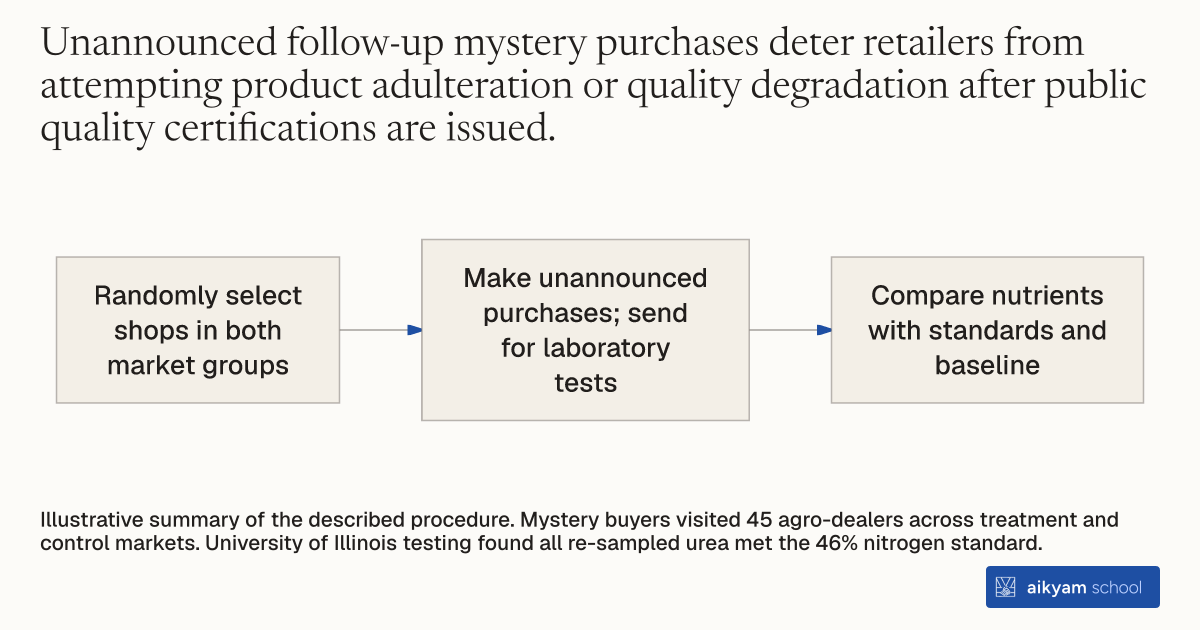
- Randomly select shops in both market groups
- Make unannounced purchases; send for laboratory tests
- Compare nutrients with standards and baseline
Illustrative summary of the described procedure. Mystery buyers visited 45 agro-dealers across treatment and control markets. University of Illinois testing found all re-sampled urea met the 46% nitrogen standard.
See source →How
When to use
Informational quality interventions in retail markets might create moral hazard if merchants assume monitoring has ended once positive quality certificates are displayed. Evaluators and program managers use this method to verify that product quality remains high over time and to detect any post-treatment product degradation.
Deploy unannounced mystery buyers to re-sample retail products across treatment and control markets following an intervention to audit ongoing quality compliance.
- Select a randomized sub-sample of retail input shops across treatment and control market clusters.
- Send unannounced mystery buyers to visit selected retail shops during the operating season.
- Purchase standard retail quantities of targeted inputs, such as 1-kilogram packages of urea fertiliser.
- Transport collected input samples to an independent university chemical testing laboratory.
- Perform chemical assays to measure the exact percentage weight of active nutrients.
- Benchmark test results against statutory legal standards and baseline findings to confirm continuous compliance.
Why it works
Laboratory assays provide objective proof of whether market quality remains consistent over time.
Example
Researchers sent mystery buyers to visit a randomly selected sample of 45 agro-dealers across treatment and control markets in Morogoro Region, Tanzania. Chemical testing at a University of Illinois laboratory established that 100% of the re-sampled urea fertiliser met international quality standards.
About the study
Participants
Random sample of 45 retail agro-dealers in treatment and control markets across Morogoro Region, Tanzania.
Study Design
Randomized post-intervention mystery shopper re-sampling combined with laboratory chemical testing.
Results
Follow-up chemical testing established that 100% of re-sampled urea fertiliser met international standards containing 46% nitrogen.