Research procedure
Observe unprompted seed recommendations
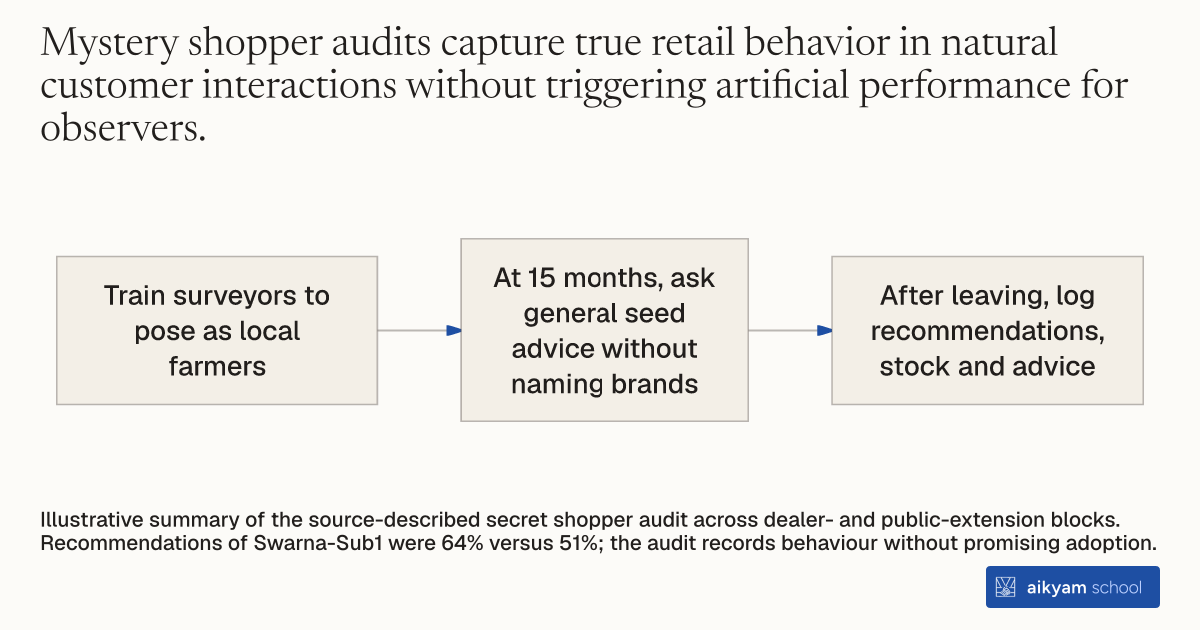
- Train surveyors to pose as local farmers
- At 15 months, ask general seed advice without naming brands
- After leaving, log recommendations, stock and advice
Illustrative summary of the source-described secret shopper audit across dealer- and public-extension blocks. Recommendations of Swarna-Sub1 were 64% versus 51%; the audit records behaviour without promising adoption.
See source →How
When to use
Self-reported survey responses from agricultural retailers often suffer from social desirability bias, making real behavior hard to track. Evaluators and project managers need an objective way to measure whether trained retailers actively recommend new technologies to customers. Deploying disguised audit surveyors directly into input supply stores measures unprompted sales advice and product promotion accurately.
Audit retailer recommendation behavior using disguised field surveyors posing as typical customer farmers.
- Train field surveyors to act as ordinary local smallholder farmers seeking seed purchasing advice.
- Schedule unannounced auditor visits to commercial agro-dealer stores 15 months after extension training events.
- Instruct each surveyor to enter target stores and request general advice on suitable rice seed varieties for local conditions without naming specific brands.
- Record whether the agro-dealer spontaneously recommends Swarna-Sub1 flood-tolerant rice seeds during the interaction.
- Log store stocking status and specific advice details immediately after leaving the store to compile objective retailer audit data.
Why it works
Observing unprompted recommendations reveals whether retailer training leads to genuine commercial promotion in real store environments.
Example
Researchers deployed disguised surveyors as secret shoppers to audit rural agro-dealers across coastal Odisha, India 15 months after extension interventions. Trained dealers spontaneously recommended Swarna-Sub1 seeds to 64 percent of secret shoppers, compared to 51 percent in comparison blocks.
About the study
Participants
Rural agro-dealers across 72 administrative blocks in coastal Odisha, India.
Study Design
Randomized audit evaluation using secret shoppers posing as local farmers seeking seed advice, visiting agro-dealers across 36 dealer-extension blocks and 36 public-extension blocks 15 months post-intervention.
Results
Agro-dealers in dealer-focused extension blocks were 13 percentage points more likely (a 25 percent relative increase from a 51 percent comparison baseline) to spontaneously recommend Swarna-Sub1 seeds to secret shoppers.