Research procedure
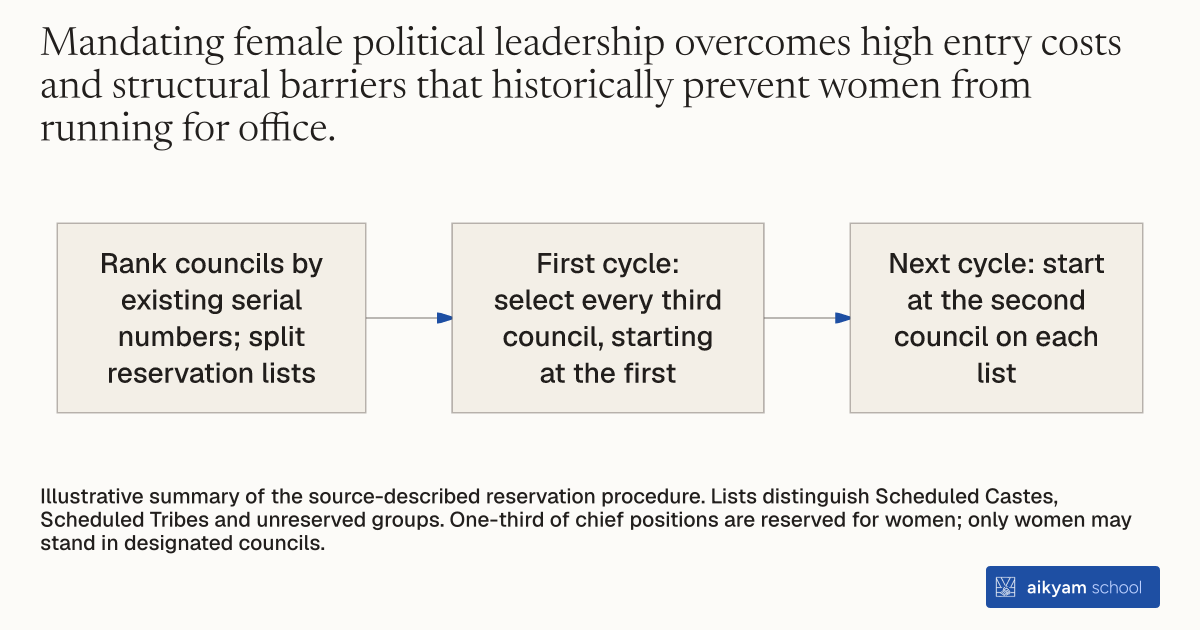
Rotate women-reserved council leadership
- Rank councils by existing serial numbers; split reservation lists
- First cycle: select every third council, starting at the first
- Next cycle: start at the second council on each list
Illustrative summary of the source-described reservation procedure. Lists distinguish Scheduled Castes, Scheduled Tribes and unreserved groups. One-third of chief positions are reserved for women; only women may stand in designated councils.
See source →How
When to use
Female leaders remain under-represented in political assemblies and local governance bodies worldwide. This policy method solves systematic political exclusion by reserving leadership seats specifically for women. It serves local governments seeking fair gender representation and unbiased policy alignment for marginalized citizens.
Reserve one-third of village council chief positions for women using administrative serial numbers and randomized rotational lists.
- Rank all local village councils in a district sequentially by pre-existing administrative serial legislative numbers.
- Divide the ranked council list into three separate sub-lists based on minority reservation status for Scheduled Castes, Scheduled Tribes, and unreserved groups.
- Select every third village council starting from the first on each sub-list to mandate a female council head for the first election cycle.
- Shift the reservation selection to start from the second council on each sub-list for the subsequent election cycle to rotate leadership opportunities across all councils.
- Restrict candidate eligibility in designated reserved councils exclusively to women so that only female politicians hold chief positions.
Why it works
Electing female leaders ensures policymaking reflects female preferences rather than being captured by elite male groups or traditional median male voters.
Example
State electoral officials in West Bengal and Rajasthan reserved one-third of Gram Panchayat chief positions for women, resulting in 100% female leaders in reserved councils compared to 6.5% in unreserved West Bengal councils and 1.7% in unreserved Rajasthan councils.
About the study
Participants
Survey of 265 Village Councils across Birbhum district in West Bengal (161 councils) and Udaipur district in Rajasthan (100 hamlets).
Study Design
Randomized policy experiment comparing public good investments and complaints between reserved female-headed councils and unreserved control councils using administrative surveys, resource maps, and meeting records.
Results
Mandated female leadership increased drinking water investments by 9.09 facilities in West Bengal and 2.62 facilities in Rajasthan, improved road conditions in West Bengal by 18 percentage points, and increased female participation in local assemblies from 6.88% to 9.80% in West Bengal.