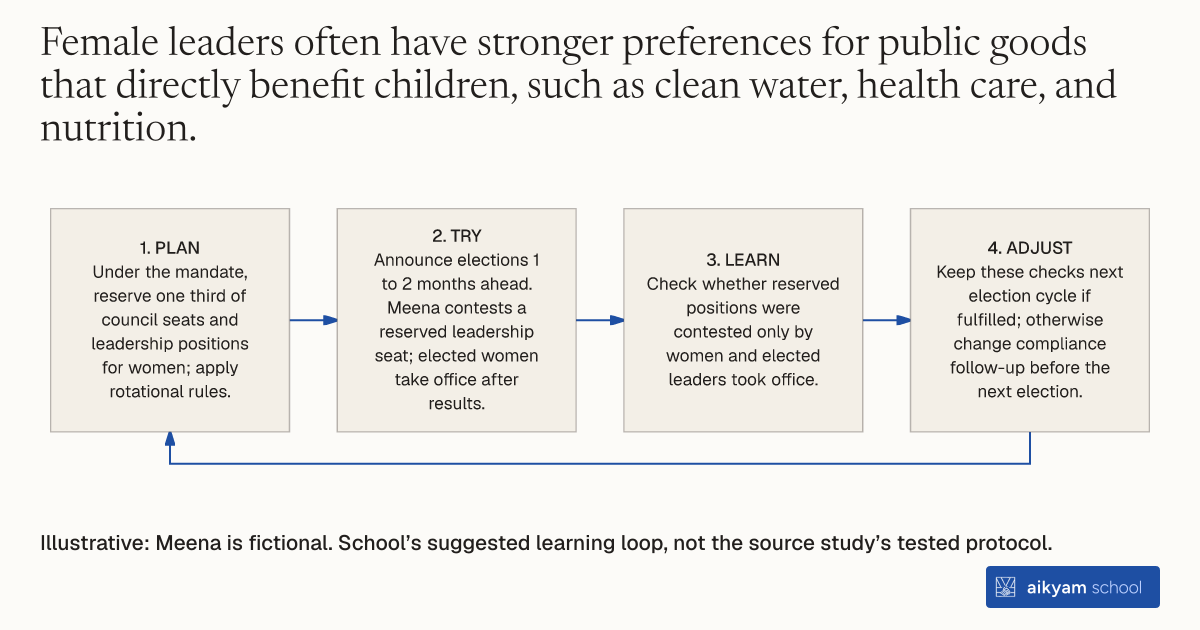
Try, learn and adjust
Check reserved leadership seats follow the mandate
- Plan: Under the mandate, reserve one third of council seats and leadership positions for women; apply rotational rules.
- Try: Announce elections 1 to 2 months ahead. Meena contests a reserved leadership seat; elected women take office after results.
- Learn: Check whether reserved positions were contested only by women and elected leaders took office.
- Adjust: Keep these checks next election cycle if fulfilled; otherwise change compliance follow-up before the next election.
Illustrative: Meena is fictional. School’s suggested learning loop, not the source study’s tested protocol.
See source →School’s suggested, untested learning loop. Observe reserved seats and office-holding; this suggested loop does not establish child development effects.
How
When to use
Rural communities often face low investments in health, nutrition, and early childhood education because local government priorities neglect mothers and young children. Mandating that a fixed share of local political leadership positions be held by women gives female leaders formal decision-making power over public resources. This method helps local governments and policymakers improve long-term child human capital in rural villages.
Reserve one third of local council leadership positions exclusively for female candidates during municipal and village elections.
- Pass state legislation under constitutional mandates requiring that one third of Gram Panchayat council seats and leadership positions be reserved for women.
- Formulate rotational assignment rules that mandate specific council head positions, such as the village sarpanch, to be led solely by female candidates in designated election cycles.
- Announce local council election dates 1 to 2 months in advance through state election commissions.
- Conduct local elections where only female candidates contest reserved sarpanch seats, placing elected women leaders in office immediately after election results.
- Empower elected female leaders to manage local public goods administration, including drinking water, health infrastructure, and public food distribution systems across village councils.
Why it works
Increasing women's political decision-making power enhances protection and resources for mothers, which improves early childhood growth and cognitive outcomes.
Example
In Andhra Pradesh, India, the state implemented mandatory seat reservation for female village council heads across 1995, 2001, and 2006 election cycles. Children who were 12 to 17 months old in 2002 and exposed in utero to 1995 female political reservation achieved test scores 0.188 standard deviations higher and height-for-age z-scores 0.258 standard deviations higher at age 8 than children exposed to female leadership only after age 5.
About the study
Participants
1,547 rural children aged 6 to 17 months in 2002 across 20 mandals in 6 rural districts of Andhra Pradesh, India, including 502 children in the main 12 to 17 month cohort tracked to age 8 in 2009.
Study Design
Intent-to-treat panel analysis exploiting the random rotational quota assignment of female village council head positions across three election cycles (1995, 2001, 2006) using three panel waves (2002, 2007, 2009) of the Young Lives Survey.
Results
Exposure in utero to 1995 female political reservation increased average test scores at age 8 by 0.188 standard deviations and height-for-age z-scores by 0.258 standard deviations, while reducing stunting probability in early childhood by 12 percentage points and increasing major child vaccination completion by 0.182 vaccinations.