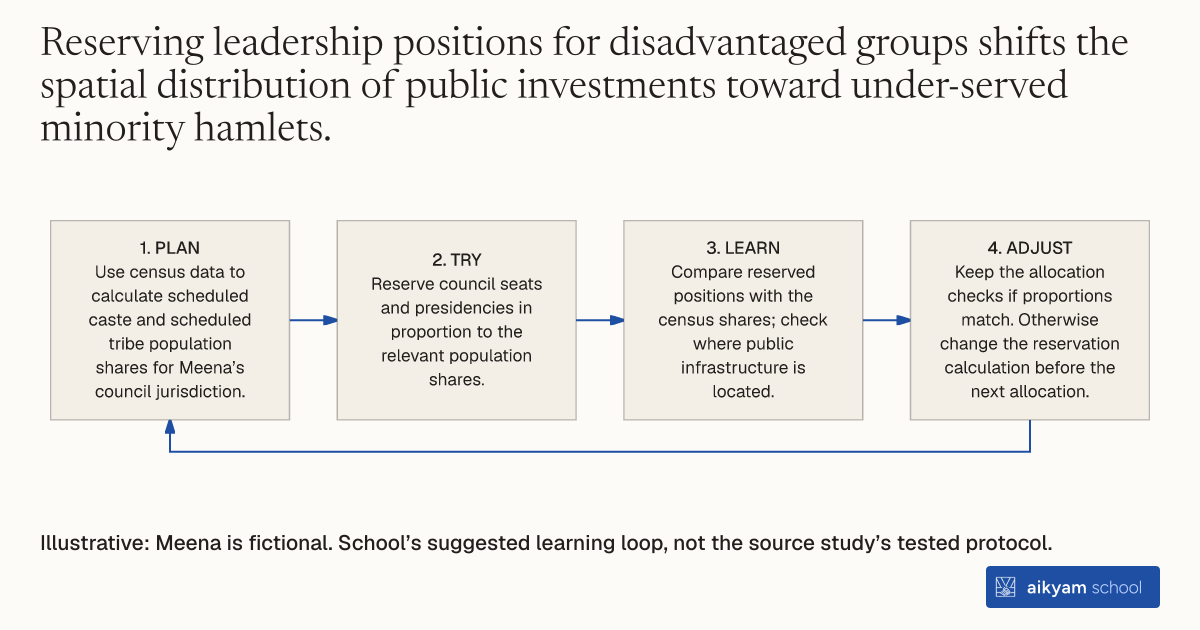
Try, learn and adjust
Check reservations match minority population shares
- Plan: Use census data to calculate scheduled caste and scheduled tribe population shares for Meena’s council jurisdiction.
- Try: Reserve council seats and presidencies in proportion to the relevant population shares.
- Learn: Compare reserved positions with the census shares; check where public infrastructure is located.
- Adjust: Keep the allocation checks if proportions match. Otherwise change the reservation calculation before the next allocation.
Illustrative: Meena is fictional. School’s suggested learning loop, not the source study’s tested protocol.
See source →School’s suggested learning loop: observe reservation proportions and infrastructure locations; this check does not establish investment effects.
How
When to use
Historically disadvantaged minority groups face political exclusion and receive inadequate public infrastructure investments in their communities. Male and non-minority leaders often concentrate public goods in majority hamlets. Mandating proportional council seats and leadership quotas for scheduled castes and tribes ensures fair spatial distribution of local public goods.
Reserve local council seats and leadership positions for disadvantaged minority groups in direct proportion to their population share.
- State electoral authorities calculate the exact population share of scheduled castes and scheduled tribes across each village council jurisdiction using national census data.
- Electoral commissions mandate that the proportion of total council seats reserved for minority representatives matches their local population percentage.
- Electoral commissions reserve council presidency positions for minority leaders in direct proportion to their total population share across council districts.
- Minority council leaders select and locate local infrastructure projects directly within historically under-served minority hamlets.
Why it works
Minority leaders understand the location needs of their communities and direct a larger share of infrastructure projects to those hamlets.
Example
In West Bengal, state authorities reserved 34.5% of council presidencies for scheduled castes and 11.5% for scheduled tribes based on population share, causing reserved councils to direct 14% more public goods investment into scheduled caste hamlets.
About the study
Participants
165 village councils in West Bengal covering rural communities with 34.5% scheduled caste and 11.5% scheduled tribe populations.
Study Design
Randomized policy evaluation comparing infrastructure locations across reserved and unreserved village councils using 1991 census baselines and village mapping surveys.
Results
Councils reserved for scheduled caste leaders allocated 14% more public infrastructure investments directly into scheduled caste communities compared to unreserved councils.