Research pricing
Separate offer price from final payment
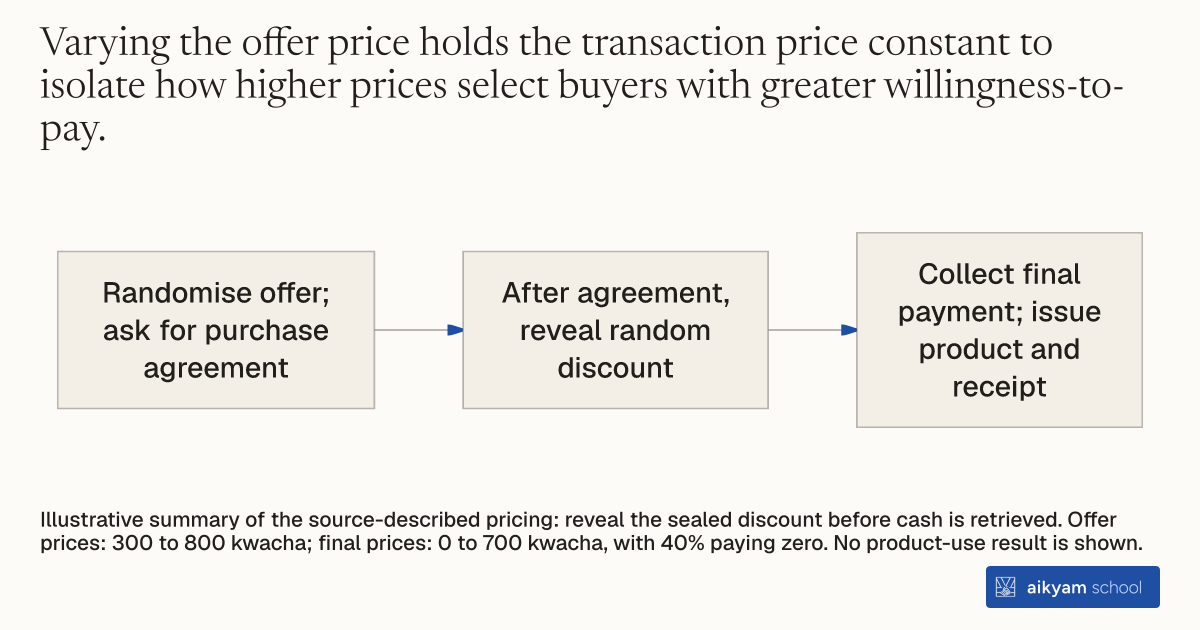
- Randomise offer; ask for purchase agreement
- After agreement, reveal random discount
- Collect final payment; issue product and receipt
Illustrative summary of the source-described pricing: reveal the sealed discount before cash is retrieved. Offer prices: 300 to 800 kwacha; final prices: 0 to 700 kwacha, with 40% paying zero. No product-use result is shown.
See source →How
When to use
Organizations distributing health goods in low-income settings often debate whether to charge fees or give items away for free. Observational sales data cannot tell whether higher prices attract consumers who use the product more or cause consumers to use the product more out of a sunk-cost feeling. This method separates initial consumer selection from post-purchase financial costs for field researchers testing pricing policies.
Set up a two-stage transaction protocol that decouples the initial purchase agreement from the final payment price.
- A trained marketer visits targeted households door to door and offers a product at a randomly assigned initial offer price.
- The marketer asks the female head of household if she agrees to buy the product at that offer price.
- If the consumer agrees to purchase, the marketer hands over a sealed envelope containing a random scratch-off discount coupon before cash is retrieved.
- The buyer opens the envelope to reveal a lower transaction price, with forty percent receiving a full discount price of zero.
- The buyer counts out and pays only the discounted transaction price, writes the amount on a signed paper receipt, and receives the product.
Why it works
Varying the transaction price for a given offer price isolates post-purchase sunk-cost effects while holding buyer selection fixed.
Example
Six marketers visited 1,260 households across five periurban compounds in Lusaka, Zambia, offering bottles of Clorin disinfectant at offer prices between 300 and 800 Zambian kwacha and transaction prices between 0 and 700 Zambian kwacha. Purchase rates dropped from 84 percent at 300 kwacha to 48 percent at 800 kwacha, while subsequent drinking water treatment increased by 3 to 4 percentage points per 100 kwacha increase in offer price.
About the study
Participants
1,260 female heads of household surveyed at baseline in five low-income periurban compounds in Lusaka, Zambia.
Study Design
Randomized controlled field experiment using a door-to-door two-stage pricing mechanism (offer prices of 300 to 800 kwacha and randomized transaction discounts of 0 to 700 kwacha) followed by unannounced household visits two weeks later to perform chemical test-strip audits for free chlorine residuals in drinking water.
Results
An increase of 100 kwacha in offer price reduced purchase probability by 6.6 percentage points (p < 0.001) but increased follow-up drinking water chlorination among buyers by 3.2 to 4.0 percentage points (p < 0.05). Final transaction prices had no statistically significant effect on purchase rates or subsequent water treatment (-0.7 percentage points per 100 kwacha, p > 0.10).