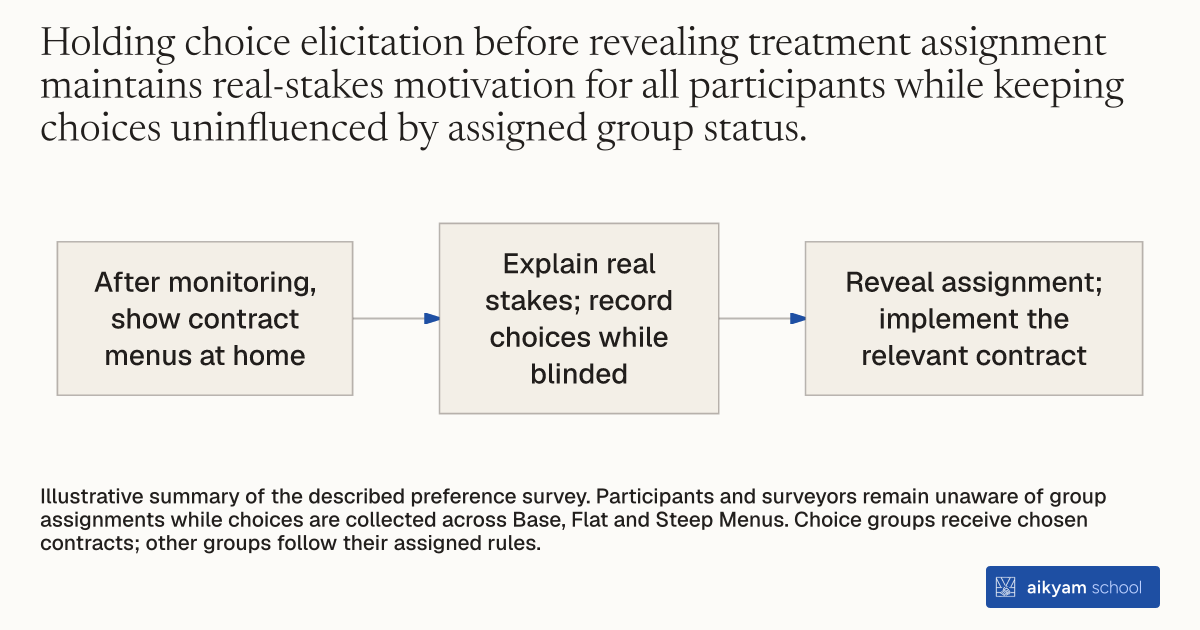
Research steps
Record choices before revealing assignment
- After monitoring, show contract menus at home
- Explain real stakes; record choices while blinded
- Reveal assignment; implement the relevant contract
Illustrative summary of the described preference survey. Participants and surveyors remain unaware of group assignments while choices are collected across Base, Flat and Steep Menus. Choice groups receive chosen contracts; other groups follow their assigned rules.
See source →How
When to use
Health programs often struggle to predict which incentive structures target populations prefer. Gathering stated choices without consequences can lead to hypothetical bias where participants do not choose thoughtfully. Gathering contract choices under real financial stakes while participants remain blinded to treatment assignments reveals true contract preferences.
Gather participants' true contract choices across policy menus by collecting decisions before revealing actual program group assignments.
- Visit participants at home after an initial monitoring period and show visual aids depicting different contract menus.
- Present each contract menu detailing step targets and daily payment amounts for meeting those targets.
- Inform participants that their choices carry a positive probability of implementation during the upcoming contract period.
- Record participant contract selections across the Base Menu, Flat Menu, and Steep Menu before revealing treatment group assignments.
- Implement the chosen contract for participants assigned to choice groups, or assign random/tagged contracts for other evaluation groups.
Why it works
Real-stakes choice elicitation prevents hypothetical bias and produces precise data on individual contract demand.
Example
Surveyors visited 6,882 adults in Coimbatore, Tamil Nadu, India, presenting visual aids of three contract menus and collecting real-stakes preferences before revealing individual treatment assignments.
About the study
Participants
6,882 enrolled participants aged 30 to 65 (mean age 49, 37% female, 31% diabetic, 32% hypertensive) in urban Coimbatore, Tamil Nadu, India.
Study Design
Real-stakes preference elicitation survey embedded in an RCT during a second household visit while participants and surveyors remained blinded to treatment assignments.
Results
Collecting real-stakes choices across all 6,882 participants provided unconfounded preference data, showing that 59% of Choice group participants selected the 10,000 target, 21% selected the 12,000 target, and 20% selected the 14,000 target on the Base Menu.