Try, learn and adjust
Check hourly emissions reports reach inspectors
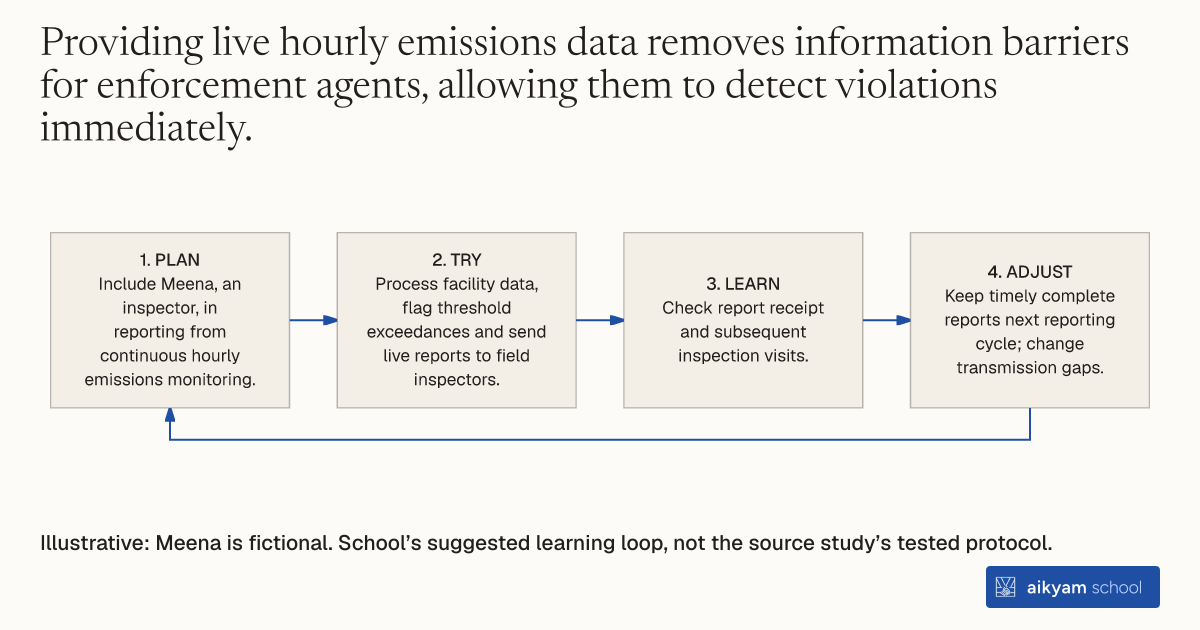
- Plan: Include Meena, an inspector, in reporting from continuous hourly emissions monitoring.
- Try: Process facility data, flag threshold exceedances and send live reports to field inspectors.
- Learn: Check report receipt and subsequent inspection visits.
- Adjust: Keep timely complete reports next reporting cycle; change transmission gaps.
Illustrative: Meena is fictional. School’s suggested learning loop, not the source study’s tested protocol.
See source →Hourly data, report receipt and inspections. Evaluation is ongoing; pollution and health effects are not established. School’s suggested learning loop, not a source-tested cycle.
How
When to use
Environmental regulators struggle to identify and target industrial firms violating pollution standards in real time. Manual and infrequent inspections allow polluting facilities to evade regulatory oversight and emit excess pollutants undetected. This method applies to national environmental inspection agencies seeking to improve the targeting of industrial pollution inspections.
Report continuous hourly emissions data from manufacturing firms directly to environmental inspectors to improve regulatory targeting.
- Environmental authorities mandate that industrial manufacturing firms transmit continuous automated hourly emissions data to central databases.
- The environmental inspection program aggregates and processes firms' hourly emissions readings in real time.
- System software generates automated reports identifying facilities that exceed allowable air pollution thresholds.
- Program officers transmit these real-time hourly emissions reports directly to field environmental inspectors.
- Environmental inspectors use the live emissions data to target inspection visits to non-compliant manufacturing plants in China.
Why it works
Real-time data targeting increases the probability of non-compliant firms facing inspection visits.
Example
In China, researchers partnered with China's National Environmental Inspection Program to evaluate reporting firms' hourly emissions data to environmental inspectors to test its effect on inspection likelihood, air pollution, and health outcomes.
About the study
Participants
Industrial manufacturing firms and environmental inspectors participating in China's National Environmental Inspection Program in China.
Study Design
Randomized controlled trial evaluating the reporting of firms' continuous hourly emissions data to government environmental inspectors.
Results
Ongoing randomized evaluation examining the impact of reporting continuous hourly emissions data to inspectors on firm inspection likelihood, local air pollution, economic output, and health outcomes.