Try, learn and adjust
Check public pollution complaints identify the regulator
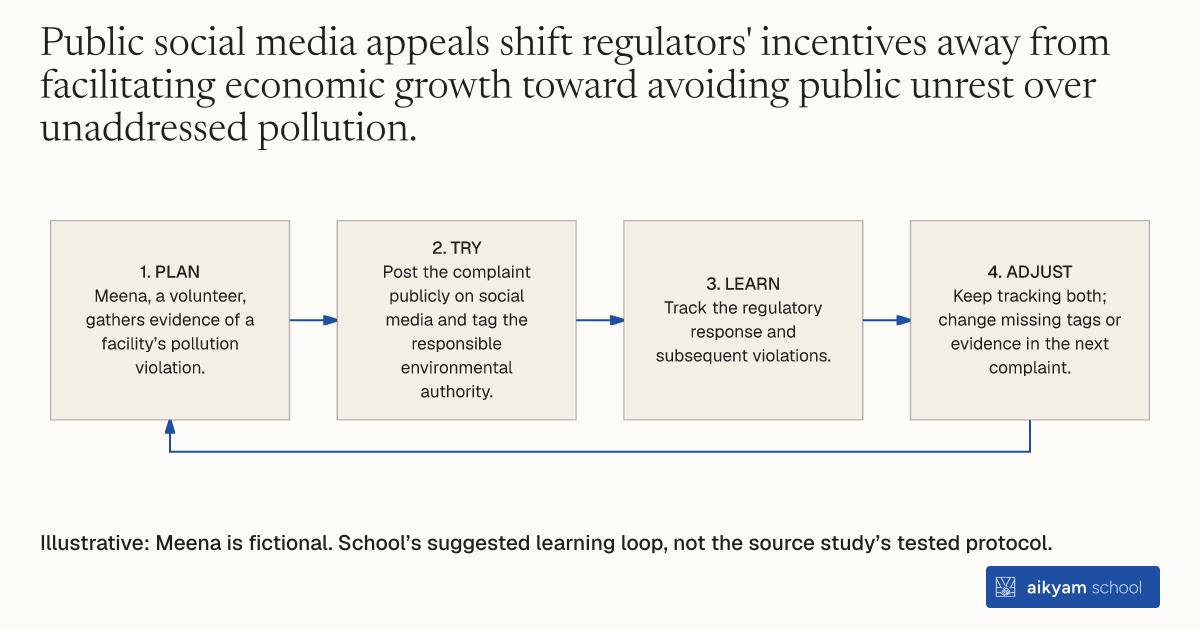
- Plan: Meena, a volunteer, gathers evidence of a facility’s pollution violation.
- Try: Post the complaint publicly on social media and tag the responsible environmental authority.
- Learn: Track the regulatory response and subsequent violations.
- Adjust: Keep tracking both; change missing tags or evidence in the next complaint.
Illustrative: Meena is fictional. School’s suggested learning loop, not the source study’s tested protocol.
See source →Evidence, regulator tags, enforcement and subsequent violations; no guaranteed response. School’s suggested learning loop, not a source-tested cycle.
How
When to use
Environmental regulatory agencies often prioritize local economic growth over enforcing pollution standards against industrial firms. Private complaints sent directly to regulators result in small enforcement responses. This method applies to civil society groups and citizen volunteers seeking to compel government regulators to enforce environmental standards against polluting firms.
Mobilize citizen volunteers to file public social media complaints that tag environmental regulators to compel enforcement against polluting firms.
- Citizen volunteers monitor local industrial manufacturing facilities for environmental pollution violations.
- Volunteers gather evidence of emissions infractions committed by polluting firms.
- Volunteers post public complaints detailing the pollution violations on a popular social media application.
- Volunteers explicitly tag the responsible government environmental regulatory authority in the public post.
- The environmental authority receives the public appeal and initiates regulatory enforcement actions against the tagged firm in China.
Example
In China, citizen volunteers publicly complained about pollution violations on a popular social media app and tagged the environmental authority, which caused targeted firms to reduce subsequent violations by over 60 percent and reduce emissions.
About the study
Participants
Citizen volunteers, industrial polluting firms, and environmental regulatory authorities in China.
Study Design
Nationwide randomized controlled trial evaluating public social media complaints tagging environmental authorities versus private complaints made to regulators or firms.
Results
Public social media complaints tagging environmental authorities led firms to reduce subsequent violations by over 60 percent and reduce emissions, while private complaints led to smaller reductions.