Try, learn and adjust
Check recruitment information and informed consent
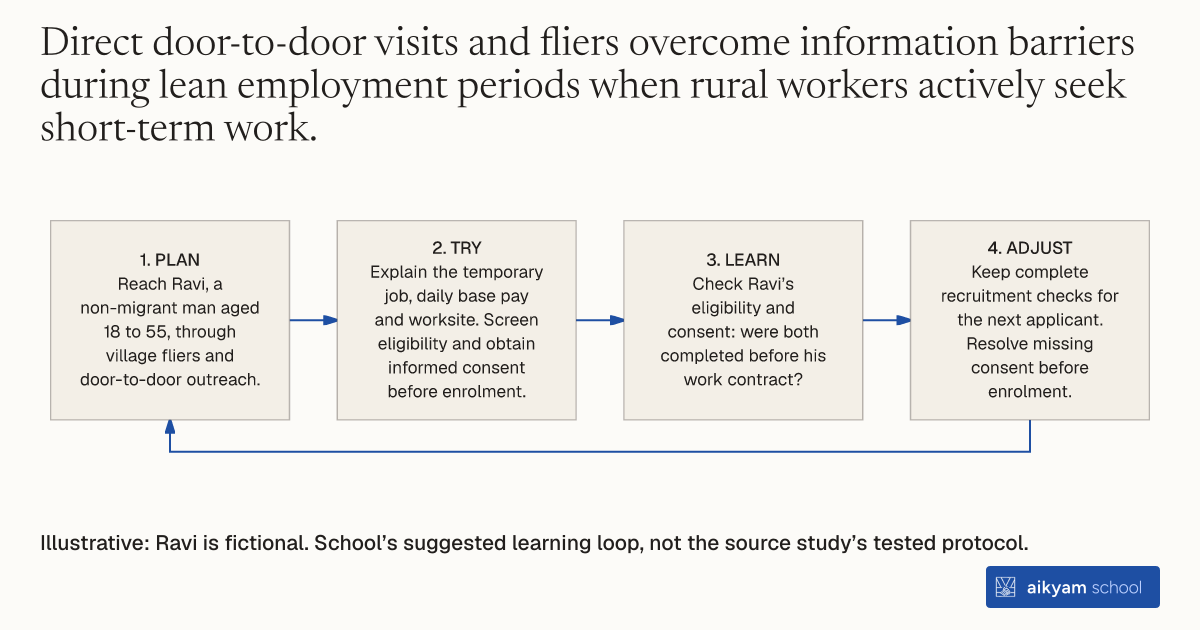
- Plan: Reach Ravi, a non-migrant man aged 18 to 55, through village fliers and door-to-door outreach.
- Try: Explain the temporary job, daily base pay and worksite. Screen eligibility and obtain informed consent before enrolment.
- Learn: Check Ravi’s eligibility and consent: were both completed before his work contract?
- Adjust: Keep complete recruitment checks for the next applicant. Resolve missing consent before enrolment.
Illustrative: Ravi is fictional. School’s suggested learning loop, not the source study’s tested protocol.
See source →School’s suggested, untested loop. Observe eligibility, job information and informed consent; recruitment alone does not establish work outcomes.
How
When to use
During agricultural lean seasons, non-migrant wage laborers face severe job scarcity and heightened financial anxiety. Short-term employment opportunities are scarce and difficult to communicate across scattered rural villages. Field teams use direct outreach to recruit local workers for temporary manufacturing contracts.
Recruit temporary seasonal wage laborers across rural communities using print fliers and direct door-to-door village outreach.
- Field recruiters visit target rural villages during the agricultural lean season when local wage work is scarce.
- Distribute advertisement fliers in public village areas detailing short-term contract work opportunities, daily base pay rates, and location details.
- Conduct door-to-door outreach to engage 18-to-55-year-old non-migrant male laborers directly at their homes.
- Screen interested candidates for eligibility and obtain informed consent prior to study enrollment.
- Contract selected participants for temporary employment at designated local worksites.
Why it works
Combining public announcements with personal home visits ensures broad reach across dispersed rural populations.
Example
Researchers recruited 408 non-migrant male wage laborers aged 18 to 55 across 47 villages in Odisha, India, using fliers and door-to-door outreach to offer a 12-day leaf-plate manufacturing contract at five worksites.
About the study
Participants
408 non-migrant male wage laborers aged 18–55 across 47 villages in Odisha, India.
Study Design
Field recruitment via fliers and door-to-door outreach for a 12-day randomized evaluation on leaf-plate manufacturing work contracts across five worksites.
Results
Enrolled 408 participants who reported high baseline financial anxiety, with 68 percent struggling to raise emergency funds and 70 percent being very worried about finances.