Research steps
Describe lapsed-cover reactivation rules
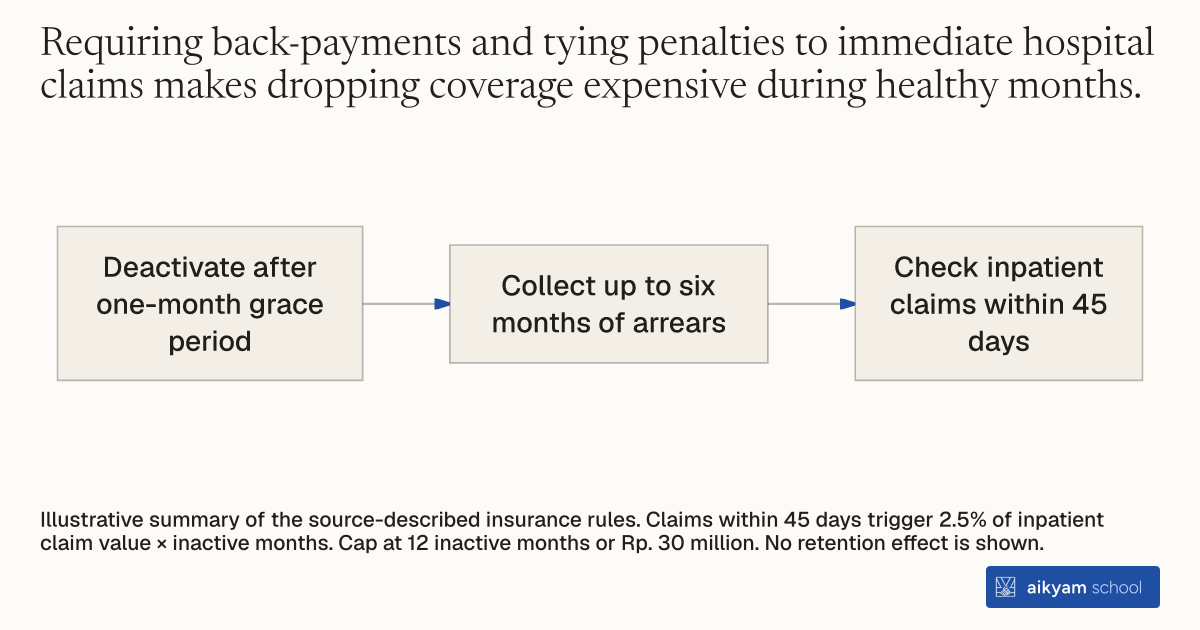
- Deactivate after one-month grace period
- Collect up to six months of arrears
- Check inpatient claims within 45 days
Illustrative summary of the source-described insurance rules. Claims within 45 days trigger 2.5% of inpatient claim value × inactive months. Cap at 12 inactive months or Rp. 30 million. No retention effect is shown.
See source →How
When to use
Uninsured informal-sector households often drop health insurance after receiving medical treatment and try to sign up again only when new health emergencies occur. This strategic dropping and re-enrolling reduces system revenue and increases financial risks for public health plans. Charging premium back-payments and claim-linked financial penalties upon reactivation deters opportunistic churn among enrolled families.
Enforce mandatory premium arrears back-payments and claim-based financial surcharges on previously lapsed households seeking health insurance reactivation.
- Deactivate insurance coverage after a one-month grace period when a household stops paying monthly premiums.
- Require the household to pay outstanding monthly premiums in arrears up to a maximum of 6 months upon applying for coverage reactivation.
- Monitor for inpatient hospital claims submitted by the reactivated household within the first 45 days of re-enrollment.
- Assess an additional penalty equal to 2.5 percent of the inpatient claim value multiplied by the number of inactive months if claims occur within 45 days.
- Cap the penalty calculation at 12 inactive months or a maximum total penalty of Rp. 30 million.
Why it works
This deters households from strategically exiting the insurance system until acute health shocks occur.
Example
Indonesia's public health insurance program required lapsed households to pay up to 6 months of premium arrears and a 2.5 percent claim penalty upon re-enrollment. Despite these penalties, 25 percent of non-subsidized enrollees dropped coverage within 3 months of joining, and nearly 50 percent dropped coverage within one year.
About the study
Participants
5,996 uninsured non-poor informal sector households in Medan and Bandung, Indonesia.
Study Design
Multi-arm randomized controlled trial analyzing high-frequency government administrative data on monthly premium payments, lapses, and claims over 20 months.
Results
One-quarter of enrolled households in the no-subsidy group stopped paying premiums 3 months post-enrollment, and nearly half stopped paying within 12 months. Coverage among full-subsidy enrollees dropped to 60 percent of year-one levels by month 20 after subsidies ended.