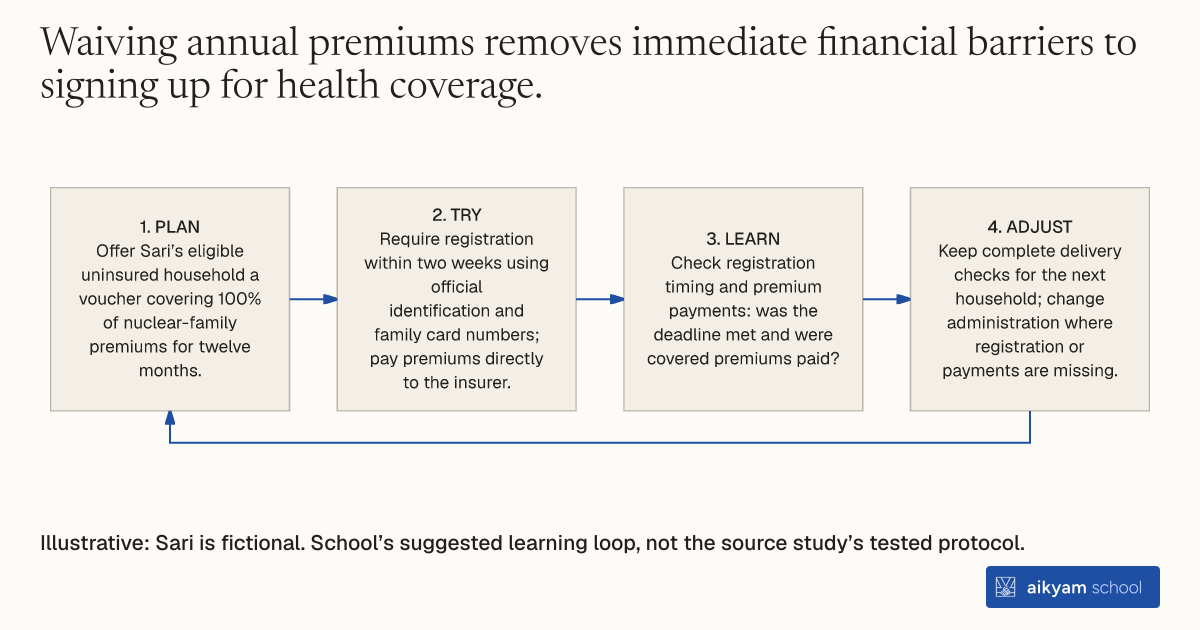
Try, learn and adjust
Check the full premium subsidy is delivered
- Plan: Offer Sari’s eligible uninsured household a voucher covering 100% of nuclear-family premiums for twelve months.
- Try: Require registration within two weeks using official identification and family card numbers; pay premiums directly to the insurer.
- Learn: Check registration timing and premium payments: was the deadline met and were covered premiums paid?
- Adjust: Keep complete delivery checks for the next household; change administration where registration or payments are missing.
Illustrative: Sari is fictional. School’s suggested learning loop, not the source study’s tested protocol.
See source →School’s suggested, untested learning loop. Observe the two-week deadline and twelve-month subsidy delivery; later coverage is not assumed for Sari.
How
When to use
Uninsured informal-sector households face low voluntary health insurance enrollment under a weakly enforced government mandate. Free enrollment offers without time constraints lead to strategic delay where people sign up only when sick. A time-limited full subsidy encourages healthy households to join before health emergencies arise.
Provide a temporary one-year full premium subsidy to eligible uninsured households under a strict enrollment deadline.
- Identify target informal-sector households who lack formal health insurance and do not qualify for poor-targeted social assistance.
- Issue a voucher covering 100 percent of monthly health insurance premiums for all nuclear family members for twelve months.
- Require the household to complete registration within two weeks of receiving the subsidy offer.
- Process registration online or in-person with official national identification and family card numbers.
- Pay monthly premiums directly to the health insurance administration on behalf of enrolled households for twelve consecutive months.
Why it works
Restricting the voucher window to two weeks prevents households from delaying enrollment until an acute health emergency occurs.
Example
Researchers offered a one-year full subsidy voucher valid for two weeks to uninsured informal households in Medan and Bandung, Indonesia. Over 12 months, the full subsidy increased enrollment by 18.6 percentage points above the control group baseline of 7.8 percent. After the subsidy expired, coverage remained 3.9 percentage points higher at month 20 than in the control group.
About the study
Participants
5,996 uninsured non-poor informal sector households in Medan and Bandung, Indonesia.
Study Design
Multi-arm randomized controlled trial comparing 100 percent subsidies, 50 percent subsidies, and zero subsidies with administrative data tracking over 20 months.
Results
Year 1 enrollment rose by 18.6 percentage points (26.4 percent versus 7.8 percent in status quo control). Full-subsidy enrollees had 40 percent lower average claim costs, 14 percentage point lower chronic condition claims, and waited 32 percent longer to submit their first claim than control enrollees.