Try, learn and adjust
Check criminal complaints are formally recorded
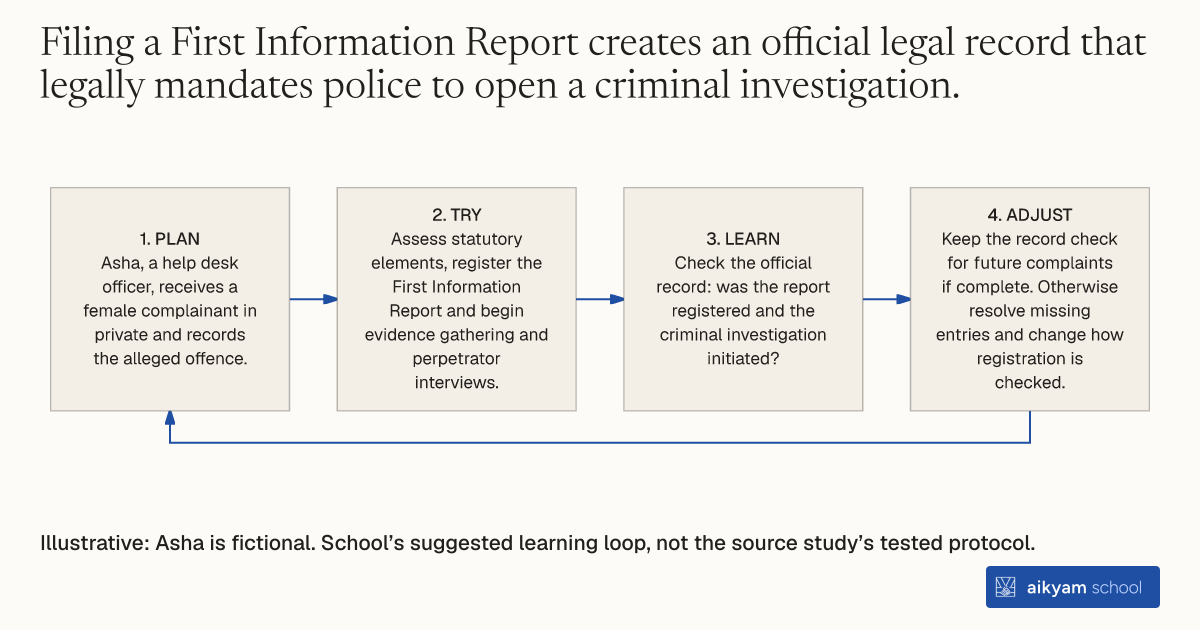
- Plan: Asha, a help desk officer, receives a female complainant in private and records the alleged offence.
- Try: Assess statutory elements, register the First Information Report and begin evidence gathering and perpetrator interviews.
- Learn: Check the official record: was the report registered and the criminal investigation initiated?
- Adjust: Keep the record check for future complaints if complete. Otherwise resolve missing entries and change how registration is checked.
Illustrative: Asha is fictional. School’s suggested learning loop, not the source study’s tested protocol.
See source →School's suggested, untested loop: observe registration and investigation records; this check does not establish prosecution outcomes.
How
When to use
Female victims of gender-based violence often face police resistance when seeking formal prosecution of violent offenses. Officers frequently avoid filing labor-intensive criminal reports due to patriarchal beliefs about preserving family unity or political pressure to under-report crime. This method uses designated help desks and trained officers to file First Information Reports that formally open criminal investigations.
Register First Information Reports to initiate criminal investigations and formal prosecution for cases of gender-based violence.
- Help desk officers receive female complainants in private intake spaces to record details of violent offenses.
- Station personnel evaluate victim allegations to identify statutory elements of criminal acts under penal law.
- Assigned officers write and officially register First Information Report paperwork to establish a criminal case record.
- Station officers initiate criminal investigations, gathering evidence and conducting perpetrator interviews for legal prosecution.
Why it works
Assigned female officers at help desks overcome patriarchal reconciliation biases and dedicate necessary officer time to document labor-intensive criminal cases.
Example
Madhya Pradesh Police stations equipped with help desks registered 3,360 additional First Information Reports across 12 districts, driven almost entirely by woman-run desks that averaged 4.4 filings per month compared to 3.8 in control stations.
About the study
Participants
180 police stations across 12 districts in Madhya Pradesh, India, serving average station catchment populations of 130,000 citizens.
Study Design
Randomized controlled trial comparing 61 regular help desk stations, 59 woman-run help desk stations, and 60 control stations evaluated from May 2019 to October 2020.
Results
Help desk stations registered 14 percent more First Information Reports for crimes against women (3,360 total additional FIRs), with woman-run desks averaging 4.4 FIRs per month versus 3.8 in control stations.