Research steps
Compare earnings around certificate cutoffs
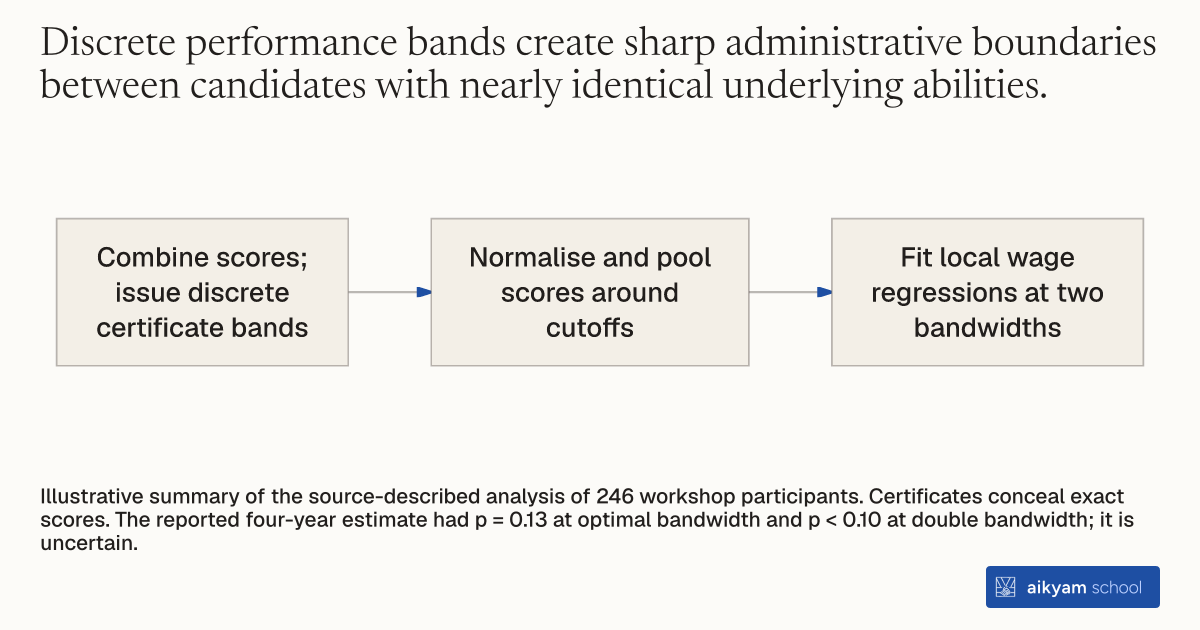
- Combine scores; issue discrete certificate bands
- Normalise and pool scores around cutoffs
- Fit local wage regressions at two bandwidths
Illustrative summary of the source-described analysis of 246 workshop participants. Certificates conceal exact scores. The reported four-year estimate had p = 0.13 at optimal bandwidth and p < 0.10 at double bandwidth; it is uncertain.
See source →How
When to use
Researchers need to isolate the pure signaling value of an official skill credential from underlying worker ability. Continuous test scores conflate true ability with the formal signal reported to prospective employers. Evaluate earnings impacts across discrete certificate performance cutoffs where underlying candidate ability is virtually continuous.
Estimate local treatment discontinuities across broad grade band boundaries on standardized skill certificates using a regression discontinuity design.
- Aggregate individual test scores from cognitive, mathematical, linguistic, and work-sample evaluations into a normalized composite index.
- Report results on participant certificates in discrete performance bands, concealing exact continuous test scores from both job-seekers and employers.
- Normalize composite test scores around each discrete band cutoff by subtracting the bin-specific cutoff score and dividing by bin-specific standard deviations.
- Pool normalized score discontinuities across performance band cutoffs to maximize statistical power.
- Estimate local linear regressions of wage outcomes on dummy indicators for scoring above cutoff thresholds using optimal and double bandwidth choices.
Why it works
Demonstrating an earnings jump at these cutoffs proves that official certificate labels independently generate signaling value in the labor market.
Example
Researchers evaluated 246 workshop participants receiving skill certificates in Addis Ababa, Ethiopia. Crossing a discrete performance band cutoff raised 4-year earnings by 0.332 standard deviations under optimal bandwidth, confirming that discrete credential labels drive wage premiums independently of underlying test score variations.
About the study
Participants
N = 246 young job-seekers assigned to the job application workshop in Addis Ababa, Ethiopia.
Study Design
Regression discontinuity design pooling normalized aggregate test score cutoffs across performance bands using rectangular and triangular kernels.
Results
Being placed in a higher certificate score band raised 4-year earnings by 0.332 standard deviations (p = 0.13 under optimal bandwidth; p < 0.10 under double optimal bandwidth).