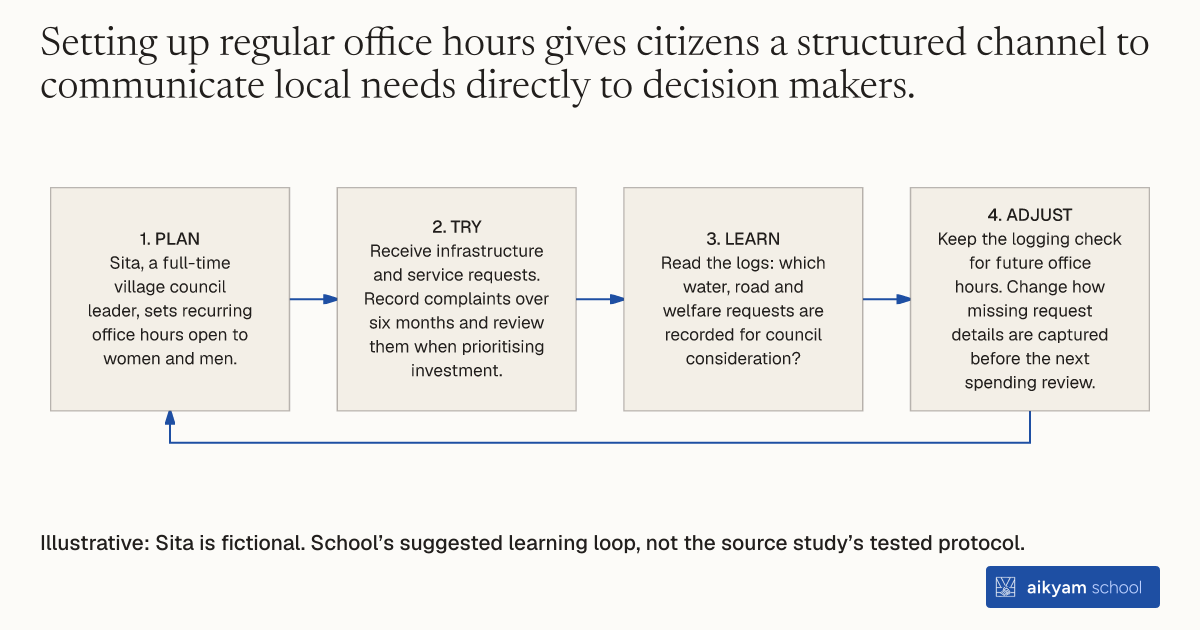
Try, learn and adjust
Check citizen requests inform council review
- Plan: Sita, a full-time village council leader, sets recurring office hours open to women and men.
- Try: Receive infrastructure and service requests. Record complaints over six months and review them when prioritising investment.
- Learn: Read the logs: which water, road and welfare requests are recorded for council consideration?
- Adjust: Keep the logging check for future office hours. Change how missing request details are captured before the next spending review.
Illustrative: Sita is fictional. School’s suggested learning loop, not the source study’s tested protocol.
See source →School's suggested, untested loop: observe citizen requests and council consideration; logging a request does not establish an investment.
How
When to use
Rural citizens frequently lack direct access to local elected leaders to express community needs and concerns. This lack of access prevents elected officials from learning about urgent infrastructure deficits, such as broken water pumps or damaged roads. Establish mandatory office hours where local villagers submit formal complaints and service requests directly to their elected village council leader.
Establish schedule-based leader office hours to receive and record citizen grievances regarding local public infrastructure and government services.
- Require the full-time village council leader to set up recurring office hours in the council jurisdiction.
- Open the council office to all female and male village residents during these designated hours.
- Invite attending citizens to lodge specific complaints or requests concerning public infrastructure, drinking water facilities, roads, and welfare programs.
- Record each submitted citizen request and complaint in official council logs over six-month tracking periods.
- Review logged grievances to inform council spending decisions and prioritize local public investments based on community demand.
Why it works
This continuous feedback reveals gender-specific policy priorities and guides council investment choices.
Example
In Birbhum, West Bengal, office hours generated complaint logs showing 31 percent of women requested drinking water and 31 percent requested road improvements, prompting female leaders to invest in 9 additional drinking water facilities and improve roads by 18 percent. In Udaipur, Rajasthan, complaint logs showed 54 percent of women requested drinking water and 13 percent requested roads, leading female leaders to add 2.62 drinking water facilities and reduce road improvements by 8 percent.
About the study
Participants
265 village councils across Birbhum in West Bengal and Udaipur in Rajasthan, India, serving rural civil servants and rural populations.
Study Design
Randomized controlled trial collecting citizen complaints and requests submitted during office hours over six months, alongside pradhan interviews, meeting minutes, and local public goods audits across three randomly selected villages per council.
Results
In West Bengal, complaint logs revealed 31 percent of women's grievances concerned drinking water and 31 percent concerned roads, compared to 17 percent and 25 percent for men; reserved female leaders subsequently built 9 more drinking water facilities and improved roads by 18 percent. In Rajasthan, 54 percent of women's grievances concerned drinking water and 13 percent concerned roads, compared to 43 percent and 23 percent for men; reserved female leaders built 2.62 more drinking water facilities and reduced road improvements by 8 percent.